Ubuntu maker Canonical announced they're going to be pushing out Linux kernel upgrades more rapidly, due to the increasing amount of security issues.
A lot of this they said is coming from "artificial intelligence: large language models (LLMs) and specialized AI agents", since now a lot more people have access to models that can quite easily scan through code to find issues. Something that previously took a lot more time and effort.
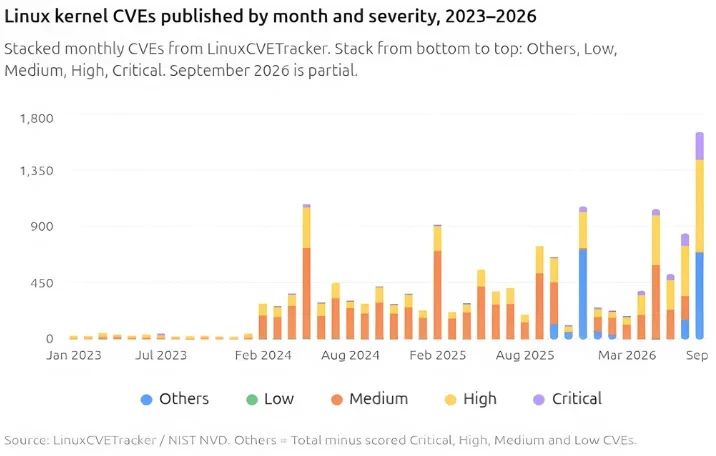
They said as the result of it that the amount of CVEs being reported for the Linux kernel has increased quickly, and if you look at the chart they included you can see it's rather dramatic:
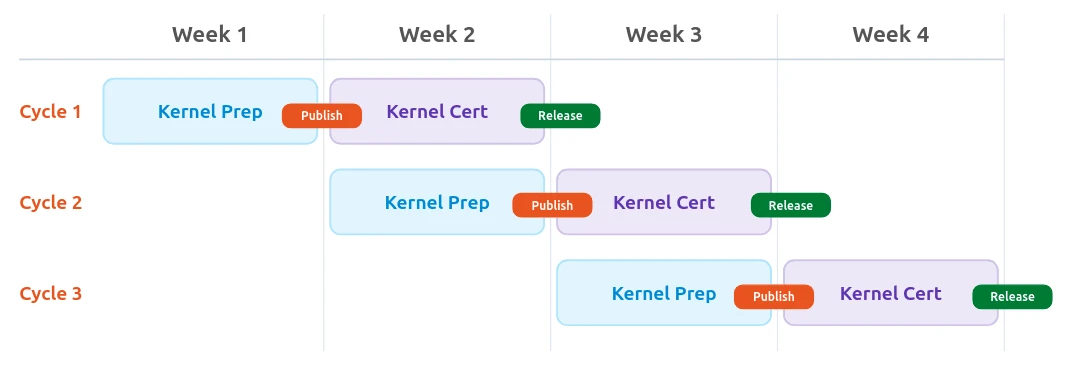
So what are they doing? Canonical are moving to a clear unified two-week cycle of releasing fresh updates to the Ubuntu Linux kernel to address the onslaught of issues. So week 1 preps and tests, week 2 goes through certification and releases at the end of it, while they begin release prep again for the following week.
What about for issues where no patch exists? Canonical said they aim to provide prompt and safe workarounds for people to use so you're not left unprotected. If nothing exists to help they said they will point users towards general hardening steps to take instead. Their overall goal is to "get environments into a defensible, safer state within 24 to 48 hours of public disclosure – well before a patch ships" to buy users time for environments where it's essential.



See more from me


 You can also find comments for this article on social media:

That must be expensive and unpopular with the admins.
Its needed, but that doesn't make it easy or cheap.


Quoting: LoudTechieWowzers.I am running a few java applications at work on 24.04 lts, I need to restart them weekly anyways (java 😂) so fits well.
That must be expensive and unpopular with the admins.
Its needed, but that doesn't make it easy or cheap.
But more seriously, this will slow down again, at a certain point the number of bugs will drop back to normal.



Quoting: TarosAll those patches go upstream I hope.More likely those patches *come* from upstream.
I'm not sure if Ubuntu sticks to the kernel.org's "long term" kernels but those get official patches for distros to apply (and if not, the patches are public anyway).
Quoting: BumadarBut more seriously, this will slow down again, at a certain point the number of bugs will drop back to normal.Let's hope so hehe, the last quartet of vulns came with an "I'm tired boss" meme and all :)
Torvalds himself said "given enough eyeballs, all bugs are shallow".
Who knew those eyeballs would be virtual...
Quoting: BumadarYou my friend underestimate severely how abysmal AI and humans are at patching and preventing security bugs.Quoting: LoudTechieWowzers.I am running a few java applications at work on 24.04 lts, I need to restart them weekly anyways (java 😂) so fits well.
That must be expensive and unpopular with the admins.
Its needed, but that doesn't make it easy or cheap.
But more seriously, this will slow down again, at a certain point the number of bugs will drop back to normal.
Warning frustrated rant:
Spoiler, click me
Cryptography at least teaches a method, although that method is "publish or perish" over the length of 20 years making it too slow.
I'm not saying there're no methods for fixing security issues in code.
I'm saying nobody has been taught them.
It has been mathematically proven that the best way to stop sql injection is through tagging, but input sanitation is still leading and sql injection thus still rampant, because nobody has been thought this.
We know hardcoded keys are only useful for malware and insecure software. Yet, nobody noticed it in the xz binary, because for some reason even virus scanners don't check for them.
Rights abstention is an option in every major OS, but nobody can use them, because nobody has been taught them.
Cryptographic libraries are super hard to use, but luckily they don't teach their use in schools or external courses.
Semi-Government bodies give all kind of secure development advice, while still shitty.
The first reaction to an open source supply chain attack is we should start sending money to the parts of the supply chain that often don't even publish a payment method. This comes from technically trained and employed people. Payment and management of individuals is a governance problem it's worth mentioning, but there is so much within our area expertise(technical) we could do it's embarrassing to only talk about what others can do about our problem.
You say, but what about Rust, formal proof and reproducible builds. This is exactly my point these are stability measures not security measures. It's just that stability helps a little with security by limiting the amount of options. Yet we hail them as champions for security. Rust is uniquely vulnerable to supply chain attacks with its don't ask don't tell policy around complex mathematical operations. It's great at preventing memory leaks from crashing your computer though.
Formal proof only proofs the math works out according to specification it gives us no way to determine what we want or even what physics, linguistics and psychology have to say about it. Also the entire field of cryptography exists, because we have convincing proof that mathematical security results in useless products.
Reproducible builds allow cumulative testing by differing parties, which works great for stability issues. In practice programs are judged by how they run and hiding an if statement is achievable.
In reality the only security specific measures I see are imposed directly on the end user MFA, S-Mode, strong passwords, no clicking on links(really that's what they are for), no running suspicious executables(people have no idea how to determine suspicious and you don't either otherwise the virus scanner would have spotted them), no foreign devices(how am I supposed to transfer files securely?) and updates every ten seconds..
Now you tell me I also wouldn't know where to start hoo let me tell you.
First what I already did:
1. I modified a landlock-make a testing tool into a security tool that would've been capable of stopping the xz attack
2. I wrote a way to include secrets at distribution time instead of compile time for software, because often that is the last time our program is in a trusted environment.
3. I wrote a shell script that instead of bashing users for not understanding that wine doesn't sandbox actually sandboxes it for them. Hiding the complexity and thus limiting mistakes.
4. I wrote a paper on a method to do secure boot without on device secrets and physics proof that it was needed.
5. I wrote an iteration on archon2 that makes wrong answers take longer than correct answers on average as an offline alternative to rate limiting.
Now what I would like to see.
1. acknowledge the xz-attack was made possible by several technical build pipeline vulnerabilities and start patching them.
a. ID isn't sufficient verification in the web of trust of an international community of workers of larger conglomerates. Patch: actually check whether or not the person you're talking to wrote the code by testing whether or not they can explain why random commits were made.
b. Bullying maintainers is easy, because they're their own moderators and nobody filters on technical relevance. Strict moderation tools requiring additional topic insight and a like button could have lessened the impact.
c. Nobody notices it if the signature, maintainer and repo of a project changes. Make git provide a warning or a block.
d. Binary blobs are accepted in open source repos. Generated data should get a script to regenerate it and there should be a tool that detects anything with to high entropy in repos. Also make a tool to generate these scripts based on key logging.
e. Tests shouldn't be able to modify outcome only judge(my make fork can help here)
f. The same person who decides the tests is also the person who writes the code obscuring it when an update only downgrades the code. Generic dynamic repo side tests based on old version of the code.
g. Hardcoded keys are accepted from any binary that's not accepted to be actively hostile to the device owner.
h. Git logs are mostly useless in security and attribution context.
2. Introduce physics and psychology into definition of "proven software"
3. A repo with software specifications for categories of software.
4. A repo with cryptographic hashes of illegal content sorted by jurisdiction and category.
5. Official keys to recognize law enforcement subpoenas(I once tried to get that using my rights as a citizen, but got tricked by legal) once again sorted by jurisdiction and tagged with the agency.
6. Security properties should be constructed to match the expectation of users.
7. Use CWE where it's intended for. Teaching software developers.
8. Start doing actual science around secret management. If you ask a cryptographer about it they answer that is a different science not specifying, which. If I look for literature all you will find is some okay government advice and disproved cooperate marketing claims.
Quoting: richarsonAnyone who appreciates the value of automation and/or has final responsibility for a software development project.Quoting: BumadarBut more seriously, this will slow down again, at a certain point the number of bugs will drop back to normal.Let's hope so hehe, the last quartet of vulns came with an "I'm tired boss" meme and all :)
Torvalds himself said "given enough eyeballs, all bugs are shallow".
Who knew those eyeballs would be virtual...
Fuzzers and theorem provers have been a thing for years before Static Modelling made it big.
The wild thing is that they're centralized.
Fuzzers came from experienced greybeards and teenagers with unhealthy interests.
Theorem provers came from academics with the need to proof themselves.
Static models come from a select set of tech companies with government connections. This both allows efficiencies that were never before possible and makes them suddenly subject to the Maastricht Treaty and other forms of hoarding power.

Quoting: LoudTechieIt has been mathematically proven that the best way to stop sql injection is through tagging, but input sanitation is still leading and sql injection thus still rampant, because nobody has been thought this.For me, the *same* issue is not SQL injection, but bash prompt injection. The whole "where is the filename?" as soon as spaces, or any shell-level characters, show up. The whole need for *every use of a variable to have quotes around it* if there is any chance that it has been affected by user-supplied data. Etc.
In fact, the whole design of unix -- all of it -- is "We trust the user is not trying to sabotage". So the user is assumed to be working with the software. And today, "the user" means "arbitrary program running with user permissions".
So fundamentally, every design choice for exposing how the system behaves to the end user is wrong.
Quoting: KeyBounceThe Unix design is, so ancient that I'm pretty certain it's slightly older than the paper I'm talking about and can thus be forgiven for not knowing this.Quoting: LoudTechieIt has been mathematically proven that the best way to stop sql injection is through tagging, but input sanitation is still leading and sql injection thus still rampant, because nobody has been thought this.For me, the *same* issue is not SQL injection, but bash prompt injection. The whole "where is the filename?" as soon as spaces, or any shell-level characters, show up. The whole need for *every use of a variable to have quotes around it* if there is any chance that it has been affected by user-supplied data. Etc.
In fact, the whole design of Unix -- all of it -- is "We trust the user is not trying to sabotage". So the user is assumed to be working with the software. And today, "the user" means "arbitrary program running with user permissions".
So fundamentally, every design choice for exposing how the system behaves to the end user is wrong.
It was the master thesis of two of the founding figures in the early hacker community, which in large part originated on Unix machines and as a counter movement to IBM's practices around it.
It can even be argued that it was back then based on modern principles that enable us today to correct for its modern weaknesses. It's very clearly based on the language hierarchy of Thomas Chomsky, which back then was somewhat new information. Yet, due to this the data language is still mostly regular allowing for tagging to be used as a solution in the first place.
This is a problem with LLM security, which have at least a contextual(as proven by Chomsky himself) and probably enumerable functional elements.
Having said that no UNIX/POSIX programming course teaches you to tag your user input yourself, nor has there been any relevant effort of the modern standards commissions to address these weaknesses.
Edit:
A relevant standards fix would be to add an (long*)args parameter with the size of the differing elements of argv to the c posix extensions to the C standard and add the requirement for strlen and its alternative to be limited by the resources offered by the OS.
Last edited by LoudTechie on 26 Sep 2026 at 10:00 am UTC
 Patreon
 PayPal