Bazzite Linux continues to be a popular choice for a SteamOS-like on handhelds, TV PCs and for desktops too with a new milestone hit. With support for many different devices, and often quite ahead of SteamOS, it's no surprise people keep choosing to use it. Especially with the focus on great gaming out of the box too.
In an official forum post founder Kyle Gospodnetich noted that they've now hit just over 100,000 Weekly Active Devices:
"The entire team here at Universal Blue is thrilled to announce that we’ve passed 100,000 weekly active users!
It’s hard to believe how far things have come in just the last 5 years. What started as a small project to bring cloud native to the Linux desktop has grown because of the people who believed in it: the contributors who spent nights fixing bugs and reviewing PRs, the folks answering questions in Discord and on the forums at 2 AM, the package maintainers keeping everything running smoothly, and the countless users who gave us honest feedback, reported issues, and told their friends to give us a try.
Bazzite started as a simple weekend project to see what it would take to make Fedora Atomic game-ready, if not for our earliest contributors showing me that there was interest in that outside of my little escapist weekend project none of this might have happened. Open source is a team sport, and this community has shown up for each other in ways that genuinely humble all of us at Universal Blue. If you’ve been here since day one or just joined last week, you’re part of why this project works the way it’s meant to - built by the community, for the community.
Here’s to everyone who makes Universal Blue feel like home. Thank you."
Kyle Gospodnetich
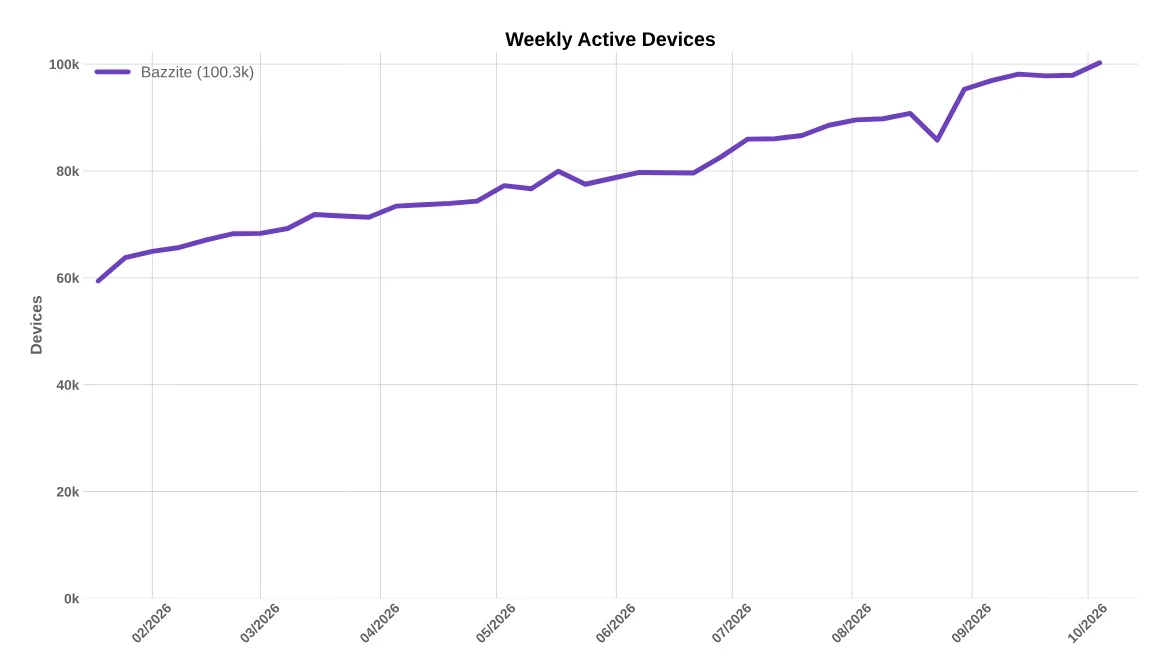
Fantastic to see. Hopefully that slow steady growth will continue. Just like we're seeing overall on the Steam Linux Survey trends. And now with the Epic Games Launcher / Store adding Linux support and improving their anti-cheat for Linux - there's never been a better time to be gaming on Linux.



See more from me



 You can also find comments for this article on social media:
 benstor214 15 Oct 2026

Quoting: devland"weekly active devices" = on by default telemetryRight, I was wondering how would they know?
No, thanks.
We, sadly, live in a world where everything is spying on you. If you’re not careful, even your toaster will snitch on you.
Last edited by benstor214 on 15 Oct 2026 at 10:55 am UTC


Bazzite comes with no telemetry of its own. It utilizes the common in all Fedora-based anonymized report system called [url=https://coreos.github.io/rpm-ostree/countme/#dnf-count-me-support]countme[/url].
You simplistically (I would not use a "stronger" word this time) confuse any sort of telemetry with spying. This attitude is helping neither open-source projects nor the real fight for privacy.

And then crying about "buuuttt linux usage is so low and noone wants to suport it" ffs…


Quoting: benstor214Bazzite is not spying on you. Feel free to review the entire source code, it's open source on Github, to verify this. Also, here is an explanation of how DNF CountMe works and the data it transmits along with the source code: (External Link: You need to be logged in to view this.)Quoting: devland"weekly active devices" = on by default telemetryRight, I was wondering how would they know?
No, thanks.
We, sadly, live in a world where everything is spying on you. If you’re not careful, even your toaster will snitch on you.
Like MiZoG already pointed out, the telemetry used here is completely anonymous and cannot be traced back to any singular person or machine. The usage data actively helps developers by letting them know which OS versions are being used more than others, for example the ratio Bazzite-Nvidia to Bazzite-Non-Nvidia. This helps them make more informed decisions about what to focus in the distro. For example, if almost nobody was using a certain version, it would make no sense to invest a significant amount of resources into new features for it.

I guess thats a power of the cloud based distro too, since taking the core ublue image, removing firefox (I do not like my browser as a system package, I want to be able to switch easily) and slapping cosmic on top was really fast and nice.


Quoting: StellaBazzite is not spying on you. Feel free to review the entire source code, it's open source on Github, to verify this. Also, here is an explanation of how DNF CountMe works and the data it transmits along with the source code: (External Link: You need to be logged in to view this.)The network traffic is encrypted so you cannot inspect the packets to confirm that no private data is collected and there's no guarantee that the binaries you download and install are using unaltered source code. So, no, I do not implicitly trust them to do what they're claiming.
Like MiZoG already pointed out, the telemetry used here is completely anonymous and cannot be traced back to any singular person or machine.
Quoting: StellaThe usage data actively helps developers by letting them know which OS versions are being used more than others, for example the ratio Bazzite-Nvidia to Bazzite-Non-Nvidia. This helps them make more informed decisions about what to focus in the distro. For example, if almost nobody was using a certain version, it would make no sense to invest a significant amount of resources into new features for it.That's corporate level BS.
You don't need telemetry to figure out if you need to support AMD/Intel gpus or any other feature.
The only reason they want the telemetry data is to peddle their services to potential enterprise clients who require "look at how many users we have" levels of persuasion in order to get them to sign a contract.
Meanwhile, the vast majority of open source projects out there do not collect telemetry because it is heavily frowned upon by the community.
The only reason bazzite got away with it is because they had it from the start. Every other Linux distro that tries to add it afterwards loses its credibility with the privacy focused crowd. Heck, even Manjaro backed out of adding telemetry collection after their community heavily opposed the idea.
Ultimately it's your choice is you use it or not but you're really not going to change everyone else's opinion on the matter. This has been discussed countless of times before and it all boils down to whether or not you trust the OS maintainers to only collect anonymous data. And you've already exposed yourself to a high level of potential intrusion if you have to trust a third party not to break their word.
Last edited by devland on 16 Oct 2026 at 6:20 am UTC

Quoting: devlandMore so, the traffic itself is encrypted so you cannot inspect the packets to confirm that no private data is collected and there's no guarantee that the binaries you download and install are using unaltered source code. So, no, I do not implicitly trust them to do what they're claiming.It's verifiable with Wireshark by dumping your SSL keys. You can build DNF from source and add breakpoints. If you can't do that you can rely on someone else to verify that for you. The "telemetry" is present in the HTTP URL of the request to whatever mirror you used.
Moreover, a very similar metric, no more anonymous, could be gotten by an actively participating mirror server, without cooperation of your local system. By just counting the first occurrence of a given source IP in a given week in the server's logs, as IP addresses are mandatory for web requests anyway.
The only information this countme setting exposes, in addition to "I live on the internet", is the installation age bucket, which is very coarse, and by necessity, the fact you do in fact use a computer with countme on.
Quoting: devlandAnd you've already exposed yourself to a high level of potential intrusion if you have to trust a third party not to break their word.This exposure happens whenever you install binary software. Or compile yourself source you have not personally thoroughly audited. It is true for all operating systems installed by an end-user. I don't see how it is relevant to the point about telemetry.
If you want software to not connect to the internet, and you don't want to audit it, and you don't want to trust any other human in the world to their word, then you will have to download the updates at a public computer and sneakernet it over to a computer inside a double-insulated Faraday cage.
So I think they do use that to make development decisions.

Quoting: devlandthere's no guarantee that the binaries you download and install are using unaltered source code.Why not? Wouldn't you be able to verify their binaries if you have the source code?
Quoting: kroltanThis exposure happens whenever you install binary software. Or compile yourself source you have not personally thoroughly audited. It is true for all operating systems installed by an end-user. I don't see how it is relevant to the point about telemetry.This exposure does not happen in systems that do not have on by default telemetry capturing.
For me it's more a matter of trust than anything because I can't afford the time to double check their packets in wireshark every other week to make sure they keep their word. I simply don't want to be in such a position.
Quoting: kroltanIf you want software to not connect to the internet, and you don't want to audit it, and you don't want to trust any other human in the world to their word, then you will have to download the updates at a public computer and sneakernet it over to a computer inside a double-insulated Faraday cage.I do audit my systems by making sure they don't send telemetry. Anything beyond that is a game of trust in which I do not want to participate.
 Liam Squires-Hand 16 Oct 2026


Quoting: devlandThis system is part of the updat system DNF. How do you know your system is sending 0 info to a server, if you use any update system? Just the act of downloading an update is a piece of information.Quoting: kroltanThis exposure happens whenever you install binary software. Or compile yourself source you have not personally thoroughly audited. It is true for all operating systems installed by an end-user. I don't see how it is relevant to the point about telemetry.This exposure does not happen in systems that do not have on by default telemetry capturing.
For me it's more a matter of trust than anything because I can't afford the time to double check their packets in wireshark every other week to make sure they keep their word. I simply don't want to be in such a position.
Quoting: kroltanIf you want software to not connect to the internet, and you don't want to audit it, and you don't want to trust any other human in the world to their word, then you will have to download the updates at a public computer and sneakernet it over to a computer inside a double-insulated Faraday cage.I do audit my systems by making sure they don't send telemetry. Anything beyond that is a game of trust in which I do not want to participate.
You first can't claim it is spyware and "corporate BS", then backpeddle to "I don't like it".
Quoting: kroltanIf you want software to not connect to the internet, and you don't want to audit it, and you don't want to trust any other human in the world to their word, then you will have to download the updates at a public computer and sneakernet it over to a computer inside a double-insulated Faraday cage.Gonna have to grind your own silicon and fabricate your own CPU too. At some point you're gonna have to trust somebody...
Quoting: Liam Squires-HandThere is nothing wrong with or evil about telemetry. I understand historically why it's a bad word to some - but developers can get a lot of truly useful data from it, to make things better. For Linux and open source it's great.I think it says a lot about who they are if it's opt-out by default. Has to be opt-in if it's gonna be the good kind of telemetry. Hopefully Bazzite is the latter, I've never used their distro.
Last edited by Slaxer on 19 Oct 2026 at 4:43 pm UTC
 Patreon
 PayPal