If you're like me and you can't get enough of bullet heaven survivor-likes, it's time to take a good look at Cloudbreaker with its inventory management. Disclosure: a key was sent to GamingOnLinux.
Far from the first to blend two interesting ideas together, but is their sky-world enough of a pull to be worth picking up? That's what I aimed to find out. It does have the expected elements of bullet heaven survivor-likes, with you auto-firing at enemies and then collecting something to level up. Although, you can manually aim any time as well. What it does with the setting is interesting though as the way you progress through it is a bit different to other games.
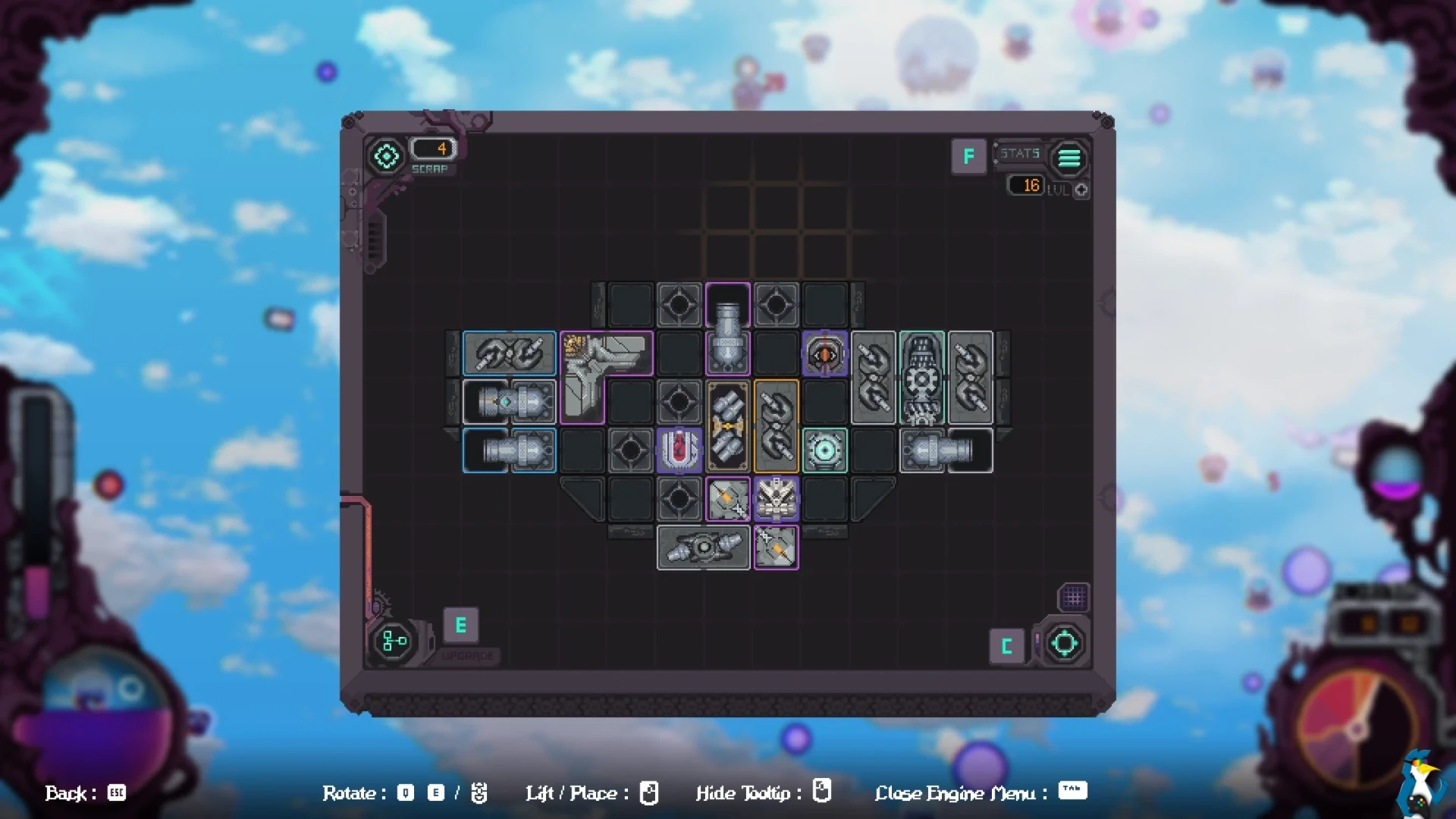
Instead of going through set levels, it's all vertical style, although it doesn't really make an different with you just moving across the map like you would in say Vampire Survivors. The level up system and inventory management together are pretty unique here. When you level up, your ship generates new parts to pick from which you then slot into free modules on your ship to add new weapons and abilities. Some modules can power up one or more other modules too by linking together across certain slots - so it's all a bit of a Tetris puzzle as you try to arrange everything together.
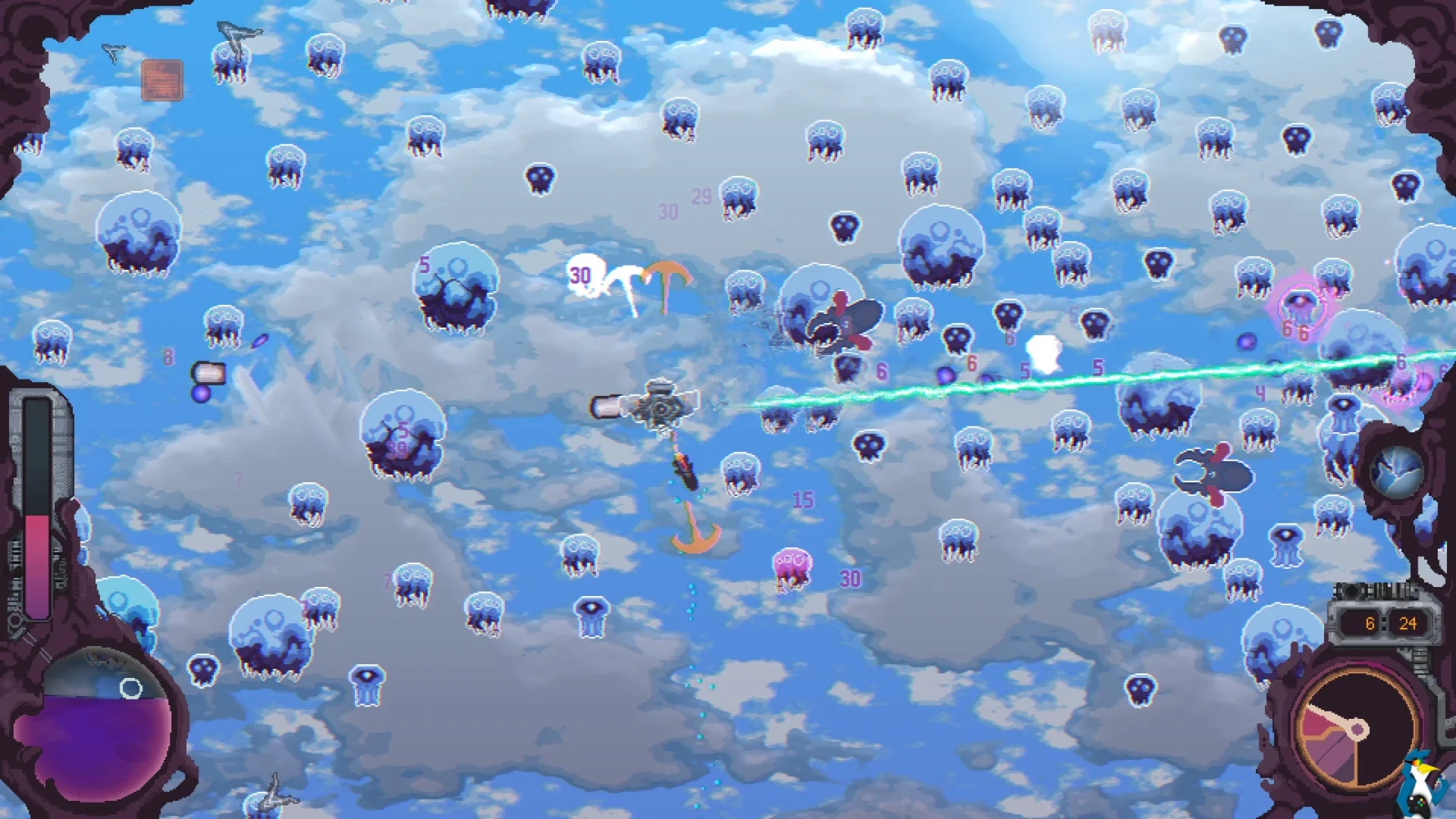
Weapons have different firing arcs too. A lot are purely directional, so where you stick them on your ship matters as much as just trying to actually fit everything in. This leads to some interesting choices you have to make. Do you focus mainly on one direction, or try to cover all around you? Either way - the swarms will challenge you.
All of the different module types are pretty easy enough to understand, with plenty of tooltips to tell you what every module does and how it will affect others. Thanks to these systems, the game definitely feels more like it wants you involved than others in the genre where you just point a direction and watch the carnage. There's still plenty of that here too though.
Add to that the ability to unlock different ships, with each having their own grid layout of where you can place modules - there's an impressive amount of variety available in play-styles. Add to that the module upgrade system, which uses collected scrap (or scrap gained from not picking a module on level-up) to allow you to permanently power up modules and turn them into something much better.
As you fly around and explore there's a good few special locations to visit. Some may be a floating turret to dock with which spams out bullets at enemies, another might give you a special relic module which will be a powerful boost for your ship. The turrets are especially useful when the waves get bigger - don't waste them like I did in my initial few runs. Having them spam out bullets, for you to quickly fly around for the upgrade orbs is an awesome boost.
There's some other parts to it to get you more involved too. There's stuff like a simple dash mechanic, but also a way to Overdrive your ship by collecting resources from special enemies. This will give you a pretty powerful momentary boost for your main weapon, as well as heal you a little. Difficult though when the enemy waves get bigger and more intense to collect the resource needed for Overdrive as it fades away somewhat quickly.
See the trailer below:

YouTube will connect and may use cookies when you accept.
- Explore & Survive – Descend through a dangerous sky-world filled with ruins, resources, and waves of enemies as you push deeper into the clouds.
- Engine Grid System – Upgrade your ship using an inventory management puzzle system where Engine Part placement determines your power and build.
- Build Synergies – Combine unique Engine Parts and relics to create powerful interactions that evolve your strategy every run.
- Unlockable Airships – Expand your fleet with ships that feature distinct Engine Grid layouts and abilities, supporting varied playstyles.
- Deep Customization – Upgrade ships and weapons through dedicated upgrade trees to tailor each run to your preferred strategy.
- Boss Battles – Take on bosses and mini-bosses that test your build and execution.
- Full Controller Support – Play with Keyboard + Mouse or full Controller support.
Cloudbreaker is not a game where you can run your brain on auto-pilot and expect to just fly through it, everything you do needs some proper thought put into it. Not just to weave in between the enemies which really does get challenging later on, but careful choices on level up of your picked modules and their placement is essential to get through it. It's a lot more demanding than it looks on the surface, with a bit of a learning curve to the module system to see what works well and what doesn't.
Helping to keep you cool under the growing pressure is the absolutely lovely ambient musical soundtrack. It's weirdly relaxing. Very much the opposite of what you would expect for such a game but it works well for Cloudbreaker.
Since release, the developers have supported it well with plenty of tweaks and upgrades to the performance to make it shine on lower-end systems and handhelds like the Steam Deck - which is also really nice to see.
My play-through has been on Fedora KDE 44 and later Fedora KDE 45 Beta with the Native Linux version using the Steam Controller and overall it was a great experience there. It has been thoroughly kicking my ass.
While it starts off a bit too slow for my liking, once it gets going and you get a fun ship build - it really ends up giving that delicious feeling of needing just one more run to see how far you can get. And perhaps, build something totally ridiculous that ends up as a flying fortress. There's really not much else out there like this. One I happily recommend to you.



See more from me




 You can also find comments for this article on social media:


 Liam Squires-Hand 8 Oct 2026

Quoting: KlaasThe configuration on the screenshot looks completely different to my usual approach on that ship. I try to throw as many overdrives onto the central engine part as possible. And lots of bloil syphons and afterburners.Huh, it never even crossed my mind to do something like that 😂, fun idea, gonna try it.
 Patreon
 PayPal