The Steam Hardware & Software Survey for September 2026 is here, showing another swing for Simplified Chinese as a language on Steam.
We've seen two months of Simplified Chinese rising now, so it's entirely possible there's an issue there - we'll keep an eye on it and update our stats if Valve do any corrections. We quite often see Linux drop when Simplified Chinese rises.
For the data right now the overall operating system stats are:
- Windows 95.03% +1.08%
- Linux 3.05% -0.85%
- macOS 1.92% -0.22%
Here's a fresh snapshot from our dedicated Steam Tracker:
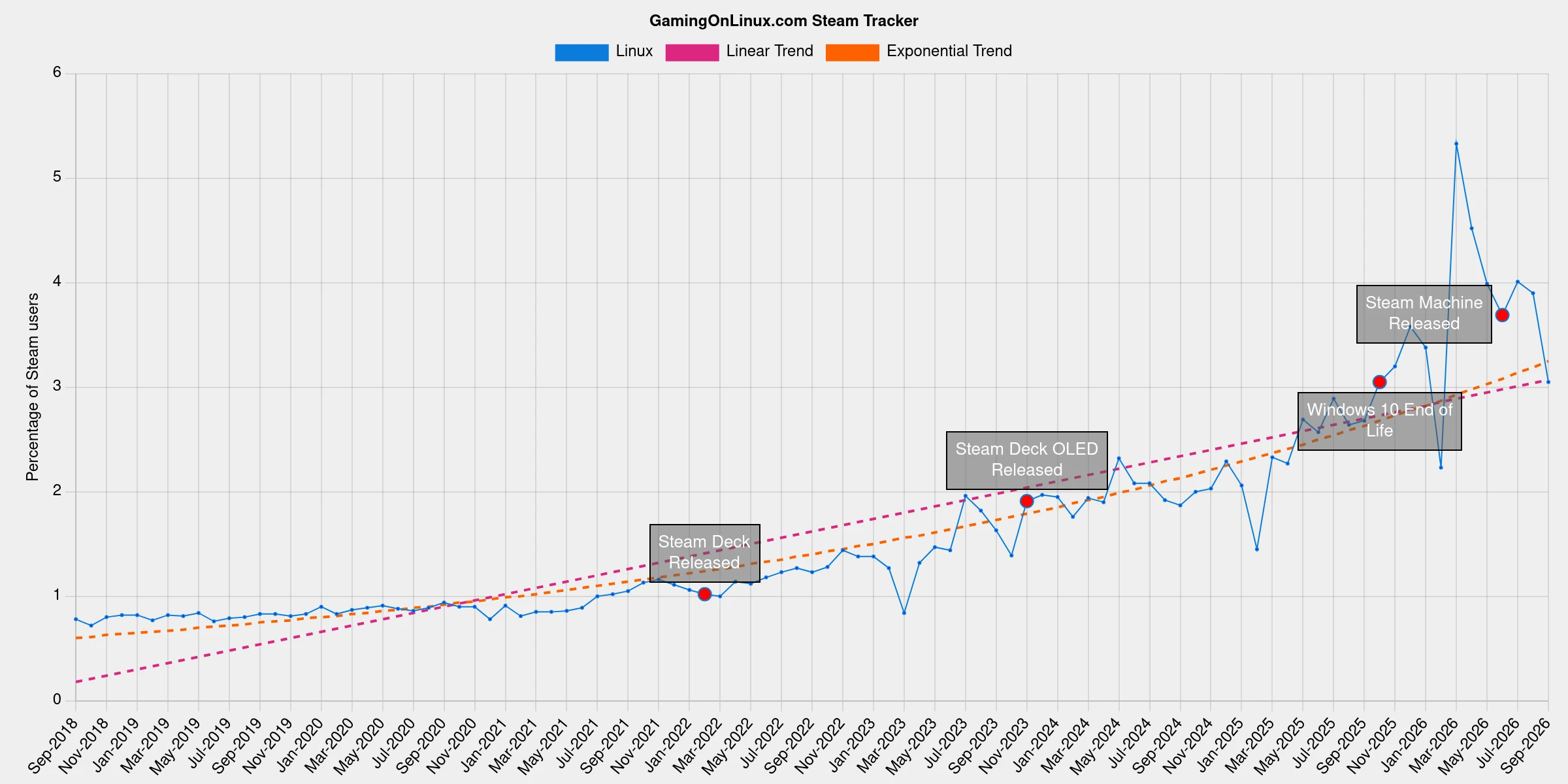
Yesterday, I also updated the WebP export download on the Steam Tracker, so it should look better now and not take the window size into account (woops). It's now a static set size - for anyone who wanted to use the data.
And the most popular Linux distributions:
- CachyOS 64 bit — 18.12% (+2.65%).
- SteamOS Holo 64 bit — 17.37% (-3.70%).
- Other — 17.37% (+4.26%).
- Arch Linux 64 bit — 10.67% (+1.89%).
- Linux Mint 22.3 64 bit — 8.74% (+0.36%).
- Bazzite 64 bit — 6.97% (-0.79%).
- Freedesktop SDK 25.08 (Flatpak runtime) 64 bit — 4.68% (-0.58%).
- Ubuntu Core 24 64 bit — 3.00% (+0.25%).
- Ubuntu 26.04.1 LTS 64 bit — 2.85% (+2.85%).
- Fedora Linux 44 (KDE Plasma Desktop Edition) 64 bit — 2.81% (-0.36%).
- Ubuntu 24.04.4 LTS 64 bit — 2.15% (-0.49%).
- EndeavourOS Linux 64 bit — 1.86% (+0.21%).
- Debian GNU/Linux 13 (trixie) 64 bit — 1.71% (-0.27%).
- Nobara Linux 44 (KDE Plasma Desktop Edition) 64 bit — 1.69% (+0.03%).



See more from me




 You can also find comments for this article on social media:


 hardpenguin 2 Oct 2026


Those big up and downs that we've seen lately, they have made me distrust on numbers (China jumping or not). We need just a little more traction, juuuust a little.
Last edited by Lin-Ursin on 2 Oct 2026 at 12:34 pm UTC

Quoting: hardpenguinFolks I think we need to start planning how to get China & Simplified Chinese speaking territories to embrace Linux for gaming 🤔Based on earlier comments on this forum.
Chinese localization with a focus on translation.
A shift to a more point and click user experience(much more international than typed commands).
Specifically translated errors.
My own speculation:
China has a lot of "sovereign" popular programs, which are badly integrated with the larger Linux ecosystem.
If your French(Ubisoft) game doesn't work Swiss developers(crossover) will with funding of an American game store company(Valve) develop a fix and potentially consult a Brazillian maintainer(Gnome).
If wchat doesn't work they can patch it using Wine or Waydroid, but since non-chinese don't use, benefit or notice problems with wchat the Chinese will have to develop and deploy the patch themselves.
HarmonyOS is an impressive piece of tech, but it needs a compatibility layer Just to support Wine, which is actually POSIX compliant. (External Link: You need to be logged in to view this.)
The solution to this might be to write open external testing suites specifically tailored to China specific porgrams.
Lots of Linux resources are probably blocked by the great firewall, because they contain political speech, text and logic the CCP openly disagrees with.
The fsf's main argument for free software is fundamentally based on the concept of individual ownership, which is something a communist party probably takes issue with.
I know the Linux kernel sometimes rejects modules for their usefulness in oppression. Often by centralizing control in the hands of a few already powerfull figures.
I think the CCP would take issue with that framing.
Lots of developers within the rust space are openly LGBTQ including in their README, which the CCP takes issue with.
The development budget of open source projects is decided by market forces.
Something a communistic organization probably takes issue with.
Mastadon mods actively avoid large players dominating.
I know for a fact wikipedia got blocked at least in part, because of the ideological exchanges on the discussion page.
The CCP is stuck separating the art and the artist, while being actively hampered in that effort by technological measures such as https.
Here the solution is obvious: develop good partial censorship tools and/or break the CCP's grip on the local network. Yet, you might notice that both these solutions are sensitive to fierce ideological debate. I for example will not be developing tools with the explicit goals to make it easier for governments to selectively remove dissenting speech.
Also I think we're working from too little data here this might not be a simplified Chinese specific problem.
It could be a more general issue, which could tell us something about the cause and thus the fix.

Quoting: LoudTechieAsian language support in general could be better on Linux.Quoting: hardpenguinFolks I think we need to start planning how to get China & Simplified Chinese speaking territories to embrace Linux for gaming 🤔Based on earlier comments on this forum.
Chinese localization with a focus on translation.
A shift to a more point and click user experience(much more international than typed commands).
Specifically translated errors.
My own speculation:
China has a lot of "sovereign" popular programs, which are badly integrated with the larger Linux ecosystem.
If your French(Ubisoft) game doesn't work Swiss developers(crossover) will with funding of an American game store company(Valve) develop a fix and potentially consult a Brazillian maintainer(Gnome).
If wchat doesn't work they can patch it using Wine or Waydroid, but since non-chinese don't use, benefit or notice problems with wchat the Chinese will have to develop and deploy the patch themselves.
HarmonyOS is an impressive piece of tech, but it needs a compatibility layer Just to support Wine, which is actually POSIX compliant. (External Link: You need to be logged in to view this.)
The solution to this might be to write open external testing suites specifically tailored to China specific porgrams.
Lots of Linux resources are probably blocked by the great firewall, because they contain political speech, text and logic the CCP openly disagrees with.
The fsf's main argument for free software is fundamentally based on the concept of individual ownership, which is something a communist party probably takes issue with.
I know the Linux kernel sometimes rejects modules for their usefulness in oppression. Often by centralizing control in the hands of a few already powerfull figures.
I think the CCP would take issue with that framing.
Lots of developers within the rust space are openly LGBTQ including in their README, which the CCP takes issue with.
The development budget of open source projects is decided by market forces.
Something a communistic organization probably takes issue with.
Mastadon mods actively avoid large players dominating.
I know for a fact wikipedia got blocked at least in part, because of the ideological exchanges on the discussion page.
The CCP is stuck separating the art and the artist, while being actively hampered in that effort by technological measures such as https.
Here the solution is obvious: develop good partial censorship tools and/or break the CCP's grip on the local network. Yet, you might notice that both these solutions are sensitive to fierce ideological debate. I for example will not be developing tools with the explicit goals to make it easier for governments to selectively remove dissenting speech.
Also I think we're working from too little data here this might not be a simplified Chinese specific problem.
It could be a more general issue, which could tell us something about the cause and thus the fix.
I use FCITX to type Japanese and it doesn't work in XWayland (which Steam's linux client runs in), nor can I have FCITX and Plasma Keyboard enabled at the same time because both are treated as virtual keyboards by the OS, which is particularly an issue for setups which alternate between physical and onscreen keyboard input, like 2 in 1 PCs.
I think FCITX should become a built in functionality of Linux, like IME is on Windows, instead of a virtual keyboard addon. And either the Xwayland keyboard issues need to be fixed or the last few holdouts (Steam, Davinci Resolve and Only Office as far as I'm aware) need to adopt Wayland.
The linux community in general is very western european and Asian computing needs/issues often go unnoticed. I think there should be an initiative to reach out to the Asian community.

Quoting: LoudTechieThe development budget of open source projects is decided by market forces.I agree with a good deal of what you wrote, but this is clearly an error. The development budget of open source projects is to a significant extent decided by market forces because we live in a society dominated by market forces. But it certainly isn't inherent in the nature of open source projects. Open source project budgets are also determined to a significant degree by charitable giving, and more to the point governments can and do both donate money to open source projects and pay in-house government workers to contribute code and so forth to open source projects, or even start and maintain their own open source projects. There is nothing inherently markety about open source.
Something a communistic organization probably takes issue with.
Not that the Chinese government would care much if there was--sure, they're "Communist", but they've also nurtured the biggest capitalist economy in the world, so . . .


Quoting: Blinky In The BuffIt's idiosyncratic, arcane in many ways, and worst of all most Linux users like it that way. Windows is a system that allows the user to operate (even if it means selling your soul). Linux is a system that you have to learn to operate (whether you want to or not). It's not a great paradigm.You can get pretty far without touching the terminal at all, if that's how you want to use it. I wouldn't say it's "arcane", it's just different. Like driving a modern electric car that does everything for you vs an internal combustion car from the 90s.
Quoting: Purple Library GuyNot that the Chinese government would care much if there was--sure, they're "Communist", but they've also nurtured the biggest capitalist economy in the world, so . . .Only in name. Their software is getting more prevalent too, which kinda worries me. Their country is on the come-up tech-wise. Seems like a pretty interesting place. Doesn't seem like you can make it there in life without your smartphone, because they've tied everything to it. Their government has total control over people there. Funny thing is, it seems like you can live a pretty comfortable life there, as long as you nod your head, and agree with everything that they tell you to do.
Quoting: VixiTo address your most direct problem(doesn't run on Wayland)Quoting: LoudTechieAsian language support in general could be better on Linux.Quoting: hardpenguinFolks I think we need to start planning how to get China & Simplified Chinese speaking territories to embrace Linux for gaming 🤔Based on earlier comments on this forum.
Chinese localization with a focus on translation.
A shift to a more point and click user experience(much more international than typed commands).
Specifically translated errors.
My own speculation:
China has a lot of "sovereign" popular programs, which are badly integrated with the larger Linux ecosystem.
If your French(Ubisoft) game doesn't work Swiss developers(crossover) will with funding of an American game store company(Valve) develop a fix and potentially consult a Brazillian maintainer(Gnome).
If wchat doesn't work they can patch it using Wine or Waydroid, but since non-chinese don't use, benefit or notice problems with wchat the Chinese will have to develop and deploy the patch themselves.
HarmonyOS is an impressive piece of tech, but it needs a compatibility layer Just to support Wine, which is actually POSIX compliant. (External Link: You need to be logged in to view this.)
The solution to this might be to write open external testing suites specifically tailored to China specific porgrams.
Lots of Linux resources are probably blocked by the great firewall, because they contain political speech, text and logic the CCP openly disagrees with.
The fsf's main argument for free software is fundamentally based on the concept of individual ownership, which is something a communist party probably takes issue with.
I know the Linux kernel sometimes rejects modules for their usefulness in oppression. Often by centralizing control in the hands of a few already powerfull figures.
I think the CCP would take issue with that framing.
Lots of developers within the rust space are openly LGBTQ including in their README, which the CCP takes issue with.
The development budget of open source projects is decided by market forces.
Something a communistic organization probably takes issue with.
Mastadon mods actively avoid large players dominating.
I know for a fact wikipedia got blocked at least in part, because of the ideological exchanges on the discussion page.
The CCP is stuck separating the art and the artist, while being actively hampered in that effort by technological measures such as https.
Here the solution is obvious: develop good partial censorship tools and/or break the CCP's grip on the local network. Yet, you might notice that both these solutions are sensitive to fierce ideological debate. I for example will not be developing tools with the explicit goals to make it easier for governments to selectively remove dissenting speech.
Also I think we're working from too little data here this might not be a simplified Chinese specific problem.
It could be a more general issue, which could tell us something about the cause and thus the fix.
I use FCITX to type Japanese and it doesn't work in XWayland (which Steam's linux client runs in), nor can I have FCITX and Plasma Keyboard enabled at the same time because both are treated as virtual keyboards by the OS, which is particularly an issue for setups which alternate between physical and onscreen keyboard input, like 2 in 1 PCs.
I think FCITX should become a built in functionality of Linux, like IME is on Windows, instead of a virtual keyboard addon. And either the Xwayland keyboard issues need to be fixed or the last few holdouts (Steam, Davinci Resolve and Only Office as far as I'm aware) need to adopt Wayland.
The linux community in general is very western european and Asian computing needs/issues often go unnoticed. I think there should be an initiative to reach out to the Asian community.
I suggest Ibus.
Does the same thing as FCITX. This comes with the expected caveat that I don't write in any of these languages and am thus unable any differences in quality between the two projects. I know the specsheet and wiki, which states(among other things) that it supports wayland and several japanese input methods/alphabets.
On your medium term problem(isn't default). I suggest integrating it into your favorite distro's installer and either making a fork out of it or getting it merged in the official distro. It's not the same as "standard on Linux", but it's part of the beginning, standardization is hard(ask the appimage people), especially with localization, because it's inherently non-standard.
On your longterm problem(lack of outreach).
I know SFC has the outreachy project to tackle these kind of issues.
The initiatives in the Indo-pacific region I've read about tend to have trouble with timezones(sleep and work need to be somewhat synchronized).
India and Australia might offer an outcome here.
Of India I know they've a lot of FOSS usage and know they have some development.
Of Australia I suspect they're just "western" enough to muscle through the problem.
Quoting: SlaxerAre you one of those people who imagine capitalism and democracy are somehow the same thing? They aren't. Exhibit A through ZZ, long lines of right wing very much capitalist dictators all over the world. So it seems to me your criticism of my point is a category error.Quoting: Purple Library GuyNot that the Chinese government would care much if there was--sure, they're "Communist", but they've also nurtured the biggest capitalist economy in the world, so . . .Only in name. Their software is getting more prevalent too, which kinda worries me. Their country is on the come-up tech-wise. Seems like a pretty interesting place. Doesn't seem like you can make it there in life without your smartphone, because they've tied everything to it. Their government has total control over people there. Funny thing is, it seems like you can live a pretty comfortable life there, as long as you nod your head, and agree with everything that they tell you to do.
They have private investors investing capital in privately owned companies which compete viciously in a capitalist marketplace to sell commodities. That's a capitalist economy. Yes, it's a mixed economy, but so are all economies and we don't quibble if someone calls the German economy capitalist.
Last edited by Purple Library Guy on 2 Oct 2026 at 10:52 pm UTC
Quoting: Purple Library GuySo it seems to me your criticism of my point is a category error.Chill out, I wasn't criticizing you at all.
Quoting: Purple Library GuyAre you one of those people who imagine capitalism and democracy are somehow the same thing?Yes, but only temporarily. Capitalism is the freedom to succeed, and the freedom to do good, or to do bad. In the end, I think the majority prefer to be told what to do. Hence why Linux is at 3%.
Quoting: SlaxerCapitalism is the freedom to succeed, and the freedom to do good, or to do bad.Sigh. (Raises finger to lecture) . . . You know, never mind.
Quoting: Purple Library GuySigh. (Raises finger to lecture) . . . You know, never mind.Don't worry about it.
I guess I'll put it this way: People aren't really built for democracy. If you go by behavior, you could probably conclude that humanity doesn't actually want democracy. Linux is at 3% and Windows is at 95%. Those may as well be votes. We have democracy, and we collectively chose to not be free. Why? In the case of OSs, probably because Linux is different and so requires one to learn something new, and make sacrifices. Learning something new might mean making mistakes, maybe feeling dumb at times, and being uncomfortable. Making sacrifices might mean going without Adobe software or Fortnite. Like Arch's AUR, Freedom is dangerous, and 9/10 we'll choose the promises of safety and life in an environment where nothing ever offends or challenges us.
With that said, I'm optimistic when it comes to Linux's market share in the gaming space. Ultimately I just think it's a better OS than Windows is. Gotta wonder if/when HarmonyOS will show up to the Steam stats.
 Caldathras 3 Oct 2026

Quoting: SlaxerI guess I'll put it this way: People aren't really built for democracy. If you go by behavior, you could probably conclude that humanity doesn't actually want democracy. Linux is at 3% and Windows is at 95%. Those may as well be votes. We have democracy, and we collectively chose to not be free. Why? In the case of OSs, probably because Linux is different and so requires one to learn something new, and make sacrifices. Learning something new might mean making mistakes, maybe feeling dumb at times, and being uncomfortable.Are you sure you are not confusing market dominance for democratic choice? In terms of the Wintel hardware sector, M$ has held market dominance for a very long time. For the longest time, they have effectively had a monopoly by being the default choice for operating system in this hardware sector. Windows is what is familiar.
This is not democratic choice, just the only option being presented. It is more the choice of the computer manufacturers, aided and abetted by M$ and software developers (who prefer a standard for ease of development). The consumer generally has no option but to accept the device as it is offered by the manufacturer. There is no democratic vote involved. This is a mercantile process not a political one.
So, what hinders the move to an alternative O/S? It's a complex issue. One aspect is that repeat users are comfortable and familiar with Windows. Most commercial software that users are familiar with is developed for the Windows ecosystem. I think you hit it on the nose at the end of your quote. The unfamiliar makes people uncomfortable, so they are less inclined to change, even if the familiar is becoming an unpleasant experience.
Quoting: CaldathrasAre you sure you are not confusing market dominance for democratic choice?For most people? I dunno if this applies. Most people don't really demand too much from their computing experience. Take my mother for example, I got her on Linux for a couple years, but she eventually demanded I reinstall Windows on her PC again simply because she didn't like that Linux was different. It's not that she had trouble using it... all she had to do was click on the browser icon, but she didn't care - it was different. So she's back on Windows now. My sister was the same way, her family's really into Google products.
For sure, MS's market dominance was more of a problem in the early 2010s, but I'm not so sure if that's much of an issue anymore. All my hardware works on Linux. I remember back when getting a printer to work on Linux used to be a problem, but it's been a breeze to setup every printer I've had to work with the last 10 years. Even with Windows' built-in ads, and the invasive AI, people still choose to use it. The spying they do doesn't seem to be a problem for most people either, in fact the second you tell someone about it you seem to become a leper. So for most people, Windows actually really sucks. For most people, Windows isn't even a good product, and bad products are not supposed to be supported by people. That's not how this is supposed to work. People generally don't care that their computing experience is becoming closer and closer to what the Chinese government does to its citizens. We have Bill C-22 here in Canada, which compels businesses to include backdoors in their service for the government to exploit at their will - and do you see anyone freaking about that? Nope. Nobody cares. So what does that mean? The thing is, freedom and democracy require eternal vigilance, as well as the knowledge that all of this is actually extremely delicate and that it has to be passed down from generation to generation with great care. The majority couldn't give a shit.


Quoting: hardpenguinFolks I think we need to start planning how to get China & Simplified Chinese speaking territories to embrace Linux for gaming 🤔Chinese companies are already building their own Linux-based OSs, simply to reduce dependency on US software.
Chinese OSs running on Chinese PCs with Chinese chipsets.
I believe we only need to wait for that to start becoming more widely used, and I don't think we're decades away from it, either.
The question is more if that new hardware will be compatible with Mesa and the likes.


Quoting: SlaxerFor sure, MS's market dominance was more of a problem in the early 2010s, but I'm not so sure if that's much of an issue anymore. All my hardware works on Linux.Unless the hardware was bought from a boutique company like System76, the hardware doesn't work because the company wanted to support Linux. It works because, there has been a convergence of the hardware. We have open standards for PCI, ACPI, USB, etc for sure. There is definitely overlap in server technology and PC technology. But, most OEMs are just re-licensing IP from Intel or AMD. If you buy a system with their IP, then likely there will have been engineering efforts by Intel or AMD and therefore, will work with Linux. Intel and AMD are supporting Linux because, they have industries (CGI and VFX for example) where Linux is the standard and the hardware needed for those industries are supported. You are benefiting from the overlap. If the convergence goes away, or those industries switch to a different OS (which I doubt), all of the support for Linux will disappear overnight. I'm sure the boutique companies like System76 only exist because of the overlap as well.
Caldathras 4 Oct 2026
Quoting: SlaxerAll my hardware works on Linux.Sadly, that's not the case for me. I have three Lenovo ThinkPads - a T520, a T440p and a T580. The WiFi card has a fully functional driver on the T520 and the T580, but not on the T440p (Intel Wireless-N 7260). I would have to buy a USB WiFi dongle for wireless functionality. Instead, I just connect up an ethernet cable for Internet access.
Quoting: SlaxerI remember back when getting a printer to work on Linux used to be a problem, but it's been a breeze to setup every printer I've had to work with the last 10 years.Me too. My first attempt had been a Brother MFC (pre WiFi). Brother provided drivers but Linux wouldn't detect the device by USB connection. I eventually worked out that I could directly connect via an ethernet cable for Linux to detect it. Ever since printers have gotten built-in WiFi, however, setting up on Linux has been pretty much automatic. (I could be wrong but I think that HP contributed a lot to that functionality working in Linux.)
Quoting: SlaxerWe have Bill C-22 here in Canada, which compels businesses to include backdoors in their service for the government to exploit at their will - and do you see anyone freaking about that? Nope. Nobody cares.I care. However, it doesn't matter to the Liberal Government that I care.
Quoting: Purple Library GuyEven when the government funds an open source project in general it's after they already exist and when they pull funding it's a setback, but not an existential problem. Reducing them to "yet another market player"(ask the bsd project they've had their funding cut several times, because of political statement of their maintainers)Quoting: LoudTechieThe development budget of open source projects is decided by market forces.I agree with a good deal of what you wrote, but this is clearly an error. The development budget of open source projects is to a significant extent decided by market forces because we live in a society dominated by market forces. But it certainly isn't inherent in the nature of open source projects. Open source project budgets are also determined to a significant degree by charitable giving, and more to the point governments can and do both donate money to open source projects and pay in-house government workers to contribute code and so forth to open source projects, or even start and maintain their own open source projects. There is nothing inherently markety about open source.
Something a communistic organization probably takes issue with.
Not that the Chinese government would care much if there was--sure, they're "Communist", but they've also nurtured the biggest capitalist economy in the world, so . . .
China can blackmail "commercial" tech executives to influence company policy (External Link: You need to be logged in to view this.).
The US can threaten to jail them or blow them up.
The EU can threaten to cut off entire markets.
Which doesn't work for a party whose development budget is only loosely related to their user base and get forked when blackmail works.
Suddenly we're in a position where governments have the power of "rich customer" instead of "the state", because threats of violence and anti-competitive behavior lose large amounts of their strength.
The charitable giving is in this case the predominant market force. Visible projects, which do things people find good and important receive more funding and patches, because people tend to give to projects they believe improve their world and/or situation(If not might I interest you in a new puppy kicking fund or developing a machine specifically for electrocuting random toddlers).
People might disagree on what makes a better world and thus aim their market weight(money and time) somewhere else, but they all get a little bit of what they paid for.
The rust people get existing power structures behaving more like they desire, the crypto people get to break existing power structures, which hurt them in the past.
Quoting: HighballIf you buy a system with their IP, then likely there will have been engineering efforts by Intel or AMD and therefore, will work with Linux. Intel and AMD are supporting Linux because, they have industries (CGI and VFX for example) where Linux is the standard and the hardware needed for those industries are supported. You are benefiting from the overlap. If the convergence goes away, or those industries switch to a different OS (which I doubt), all of the support for Linux will disappear overnight. I'm sure the boutique companies like System76 only exist because of the overlap as well.I remember at my first job in the VFX industry around 2006 we were using Linux. Running Digital Fusion on CentOS. I can't see it disappearing overnight like that, since Linux is pretty entrenched in areas like that. The hardware support has been this way for decades now. All my Wacom stuff works too.
Quoting: CaldathrasSadly, that's not the case for me. I have three Lenovo ThinkPads - a T520, a T440p and a T580. The WiFi card has a fully functional driver on the T520 and the T580, but not on the T440p (Intel Wireless-N 7260). I would have to buy a USB WiFi dongle for wireless functionality. Instead, I just connect up an ethernet cable for Internet access.Oh yeah, that's true. Laptop hardware support has never been 100%. When it comes to desktop\server hardware, I think we're doing pretty good on that now. Or maybe I'm just lucky, because it's been a long time since I've had hardware support issues on Linux. All my controllers always work out of the box, and my Wacom gear all works too.
Quoting: CaldathrasI care. However, it doesn't matter to the Liberal Government that I care.I'm glad you do. Really though... issues like C-22 should be front and center in our country right now. Everyone - and I mean EVERYONE - that believes that Canada is a free country should be concerned about this in the same way that they'd be concerned if there was a serial town pervert out on the loose that has managed to install cameras in women's change rooms. It shouldn't just be Canadians that are concerned either, it should be everyone living in the US, the UK, Australia, and NZ. Everyone in those countries should be looking at us like, "What the fuck are you doing!?". But no... they're not concerned about that. Apparently everyone's fine with it. Have you seen Carney's poll numbers lately? Everyone here likes him, which means this is what we want. We have democracy, and we are voting to NOT have democracy. Same goes for the software we use.
Quoting: SlaxerI can't see it disappearing overnight like that, since Linux is pretty entrenched in areas like that.I doubt they will have any reason to switch as well. But, it took the entire GFX and VFX industry 18 months starting in 2001 to switch over to Linux and PC hardware (which included an attempt to switch over to Windows as well). Prior to that, they were using expensive Unix workstations. All it would take is another necessary hardware shift and a required proprietary OS. I'm sure SGI never thought PC hardware would ever catch up to the workstation hardware.
 Patreon
 PayPal