Support us on Patreon
 PayPal
Developer Natalie Vock working for Valve has sent in even more impressive performance improvements for AMD GPUs on Linux with Mesa. This is additional work on top of what was merged recently, and that was already impressive.
The first that was sent into Mesa 2 days ago and already merged titled "Use wave32 for RT on gfx11+", in the request they noted:
ACO got a lot better at forming VOPD instructions, and testing
feedback seems to point in a slightly positive direction for this.gfx12 will also start requiring wave32 for dynamic VGPR allocation at
some point.Measurements on navi31:
Cyberpunk 2077:
Difference at 95.0% confidence
1.12333 +/- 0.42876
1.88216% +/- 0.718391%
(Student's t, pooled s = 0.189165)Black Myth Wukong benchmark:
Difference at 95.0% confidence
4 +/- 1.30862
13.9535% +/- 4.56495%
(Student's t, pooled s = 0.57735)Portal with RTX:
66.2ms->61.5ms (~7.64% improvement)
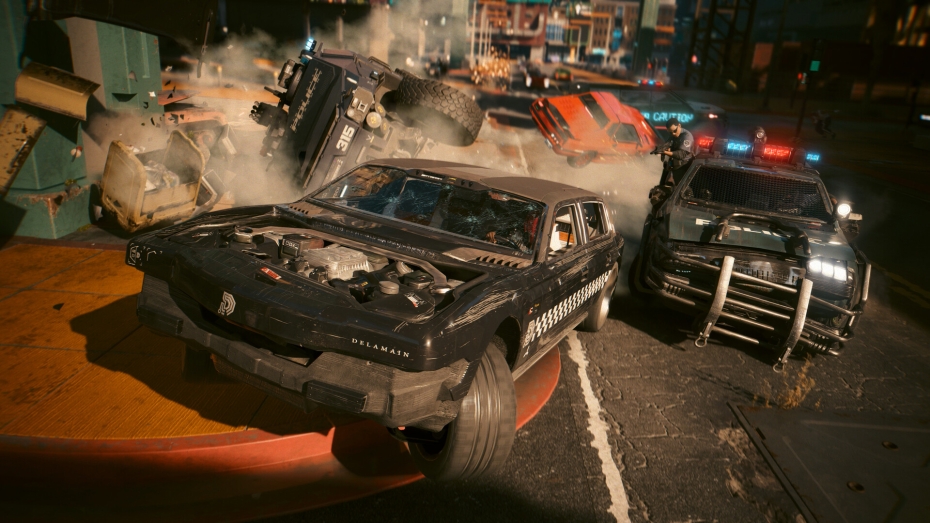
Pictured - Cyberpunk 2077
The second that was opened around 20 hours ago titled "Use function calls to separate out any-hit/intersection shader compilation" is just as impressive:
We finally have function calls for raytracing!
Now, let's use them for really cool stuff.
With this MR, RADV can compile any-hit and intersection shaders separately. No more forced inlining of everything into one humongous megashader! In games that heavily use/compile any-hit/intersection shaders, this entails some really crazy improvements across all GPU generations:
Compiling RT pipelines in UE4 games with raytracing (e.g. Ghostwire Tokyo, The Callisto Protocol) becomes 10 times faster. Yes, an order of magnitude! In one Ghostwire Tokyo Fossilize capture I gathered, time to replay went from 4 minutes and 20 seconds to just 20 seconds.
These UE games also tended to have quite terrible stuttering whenever a new RT pipeline was compiled.
That stuttering is gone completely.On top of that, runtime performance improves by a lot [in affected applications] as well. Who knew that inlining hundreds of shaders into an incredibly hot loop might be bad for performance?!
From quick napkin math, I think the pure RT performance in Ghostwire Tokyo improves by over 2x. In any case, FPS goes from ~30 to ~40 on my 7900XTX.
It seems like with the MR, we roughly match Windows performance in the Ghostwire Tokyo scene I tested, as well.Performance improvements on different apps/non-UE4 titles may vary, but I'm pretty sure quite a few apps should benefit. (Cyberpunk 2077 doesn't, though. It only really uses 1 any-hit shader at the maximum and is therefore unaffected by this MR.)
For the MR organization:
This is based on !38679 for good register allocation in any-hit shaders.
Most other ACO commits (529b0546, 40b49ff5 and 9702e59e) are sort-of optional - they improve performance, but this MR is beneficial with or without them. I can split them out to another MR if preferred.
Original Source: Phoronix
Hopefully there won't be any regressions found later from all this, but my totally not an expert brain is hoping this keeps coming. 2026 is going to be strong for open source Linux graphics drivers.
I imagine a fair amount of this work is towards getting the new Steam Machine ready.
As for when to expect the next Mesa releases? From the release schedule:
|
Branch |
Expected date |
Release |
Notes |
|---|---|---|---|
|
25.3 |
2026-01-14 |
25.3.4 |
|
|
2026-01-28 |
25.3.5 |
||
|
2026-02-11 |
25.3.6 |
Last planned 25.3 release |
|
|
26.0 |
2026-01-21 |
26.0.0-rc1 |
26.0 branchpoint |
|
2026-01-28 |
26.0.0-rc2 |
||
|
2026-02-04 |
26.0.0-rc3 |
||
|
2026-02-11 |
26.0.0-rc4 |
or 26.0.0 final |





See more from me



 You can also find comments for this article on social media:



Quoting: eevWhatever the price may be, I'm hoping Valve can at least make the new Machine a very stable experience with all the lessons learned through the Deck and with these updates. We should all care a bit more about the easy on boarding for people unfamiliar with Linux and PCs perhaps, especially in keeping performance up.I agree. Even if the Steam Machine turns out a failure, the software improvements will hopefully be a huge boon for Linux distros.

 Arehandoro 15 Jan 2026


Quoting: ArehandoroWas Mesa 26 the one that was going to also bring a tone of improvements to Indiana Jones? I wanted to play it soon.yes, it fixes the insane stuttering that drops fps down to the tens in most areas of he game