Initially Valve's Steam Hardware & Software Survey for December 2025 showed Linux at 3.19%, but they appear to have amended it with a nice boost for Linux. There were a few issues I spotted like languages and such not adding up, but now they do so it appears there's a few corrections that were made to it this month.
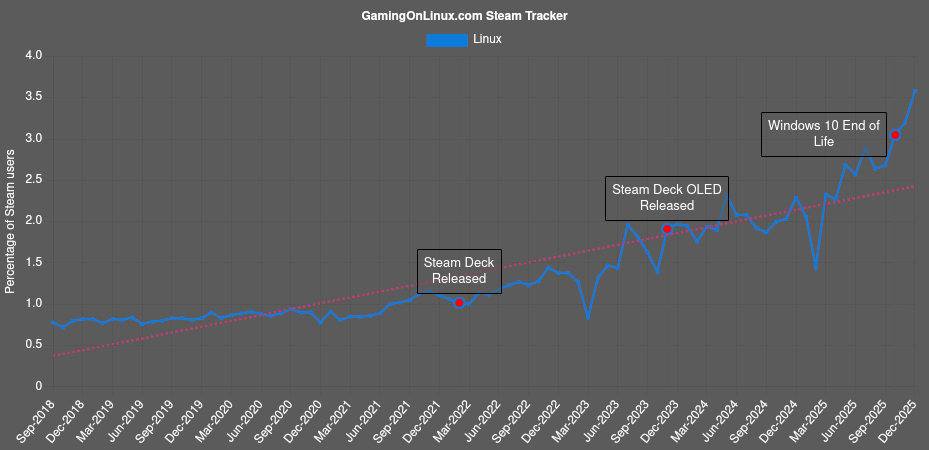
Now the latest figures from Valve show for December 2025:
- Windows: 94.23%
- Linux: 3.58%
- macOS: 2.18%
And here's our amended trend chart from our dedicated Steam Tracker page with the new data:
From the new data the most popular Linux distributions for December 2025. With the update, we see a few more distributions being noted in the list compared with before:
- SteamOS Holo 64 bit 26.32% -0.10%
- Arch Linux 64 bit 9.54% -0.43%
- Linux Mint 22.2 64 bit 7.85% +0.49%
- CachyOS 64 bit 7.20% +0.46%
- Freedesktop SDK 25.08 (Flatpak runtime) 64 bit 6.29% +0.33%
- Bazzite 64 bit 5.89% +0.36%
- Ubuntu 24.04.3 LTS 64 bit 3.93% +0.07%
- Ubuntu Core 24 64 bit 3.23% +3.23%
- EndeavourOS Linux 64 bit 2.12% +0.02%
- Fedora Linux 43 (KDE Plasma Desktop Edition) 64 bit 1.91% +1.91%
- Manjaro Linux 64 bit 1.73% -0.17%
- Debian GNU/Linux 13 (trixie) 64 bit 1.72% +0.14%
- Pop!_OS 22.04 LTS 64 bit 1.64% -0.26%
- Fedora Linux 43 (Workstation Edition) 64 bit 1.54% +1.54%
- Linux Mint 22.1 64 bit 1.42% -0.54%
- Other 17.67% -2.76%
When the data originally came out Debian 13, Linux Mint 22.1, Fedora Linux 43 (Workstation Edition) and Ubuntu Core 24 were not present. Ubuntu Core 22 no longer appears in it replaced with Ubuntu Core 24.
For those curious on how much the Steam Deck is pushing the number up, when checking out the Linux stats Valve report the "AMD Custom GPU 0405" (Steam Deck LCD) at 13.37% and the "AMD Radeon Graphics (RADV VANGOGH)" (Steam Deck OLED) at 12.48% so together it's about 25.85%.
There's still some issues with the survey, but mainly down to presentation with things being all out of order. Hopefully they get around to fixing that sometime too.
Source: Valve





See more from me



 You can also find comments for this article on social media:
Quoting: CajunMosesIt's a very nice trend. But there are too many variables to predict what will happen. It helps that Linux seems to be getting more positive press lately. And lot's of disenfranchised desktops/laptop should have been freed up by the TPM 2.0 debacle; so, hopefully some of that will continue to come back online with Linux. But it won't last forever.This isn't your fault, but I'm going to complain about a mistake you make that's intentionally very common.
It's not the fault of the TPM2.0 basically every machine, since 2008 has one that can be manually activated.
Microsoft has a processor whitelist for Win11 and that one is at fault for this debacle.
I've done Win11 migrations for many customers and none of them had no TPM2.0.
Most of them had non-whitelisted CPUs.
Microsoft does say it in it's marketing though.
This is, because the reason behind the whitelist is complicated and thus unsuited for marketing.
At the time of establishment this whitelist contained only CPU's without known side channel attacks.
They really, really wanted to get rid of old side channel attacks for some reason.

Quoting: LoudTechieThis is, because the reason behind the whitelist is complicated and thus unsuited for marketing.After what I gathered from the side channel attack history (which is not too much), I expect every current processor to have some side channel weakness too, though.
At the time of establishment this whitelist contained only CPU's without known side channel attacks.
They really, really wanted to get rid of old side channel attacks for some reason.
Quoting: EikeI'll be more clear and accurate.Quoting: LoudTechieThis is, because the reason behind the whitelist is complicated and thus unsuited for marketing.After what I gathered from the side channel attack history (which is not too much), I expect every current processor to have some side channel weakness too, though.
At the time of establishment this whitelist contained only CPU's without known side channel attacks.
They really, really wanted to get rid of old side channel attacks for some reason.
I oversimplified some things.
The moment that whitelist was released.
For all of the processors that weren't on it, there was at that very moment a paper that explained how to extract or change the things even the OS and BIOS don't have access to or it was some obscure processor Win11 was truly incompatible with(non amd64 or ARM), with physical access.
Most of the time these were side channel attacks, because those are conceptional the simplest.
On your expectation. Oh, totally. Many of the processors on the list have been already broken.
Now on why Microsoft might still want to still rid themselves of old attacks.
In the processor secrets: things like somewhat functional DRM, anti-cheat, secure boot and other attempts at limiting software freedom tend to be based on these secrets(Also bitlocker keys, but those were just an excuse).
These things are in basically all their current implementation all backed by security through obscurity. That's also generally vulnerable, but they don't care, since it still slows attacks and is super profitable.
This could be an attempt to placate their government and media backers.
Quoting: DrakkerTime to switch to an exponential trend line!I'd be happy with one that mirrored Firefox usage vs IE

I am excited for when Steam survey pops out... I have a surprise for them. Finally got my hands on 5950x!
The GPU is old as fuck but who cares about this things? Most of the time when I game (which happens more and more rare this days) I lean towards playing CS 1.6... xD
 Patreon
 PayPal