 Support us on Patreon
 PayPal
Return to Part 1: Dumpster Diving
Continued from Part 49: One More to Go!
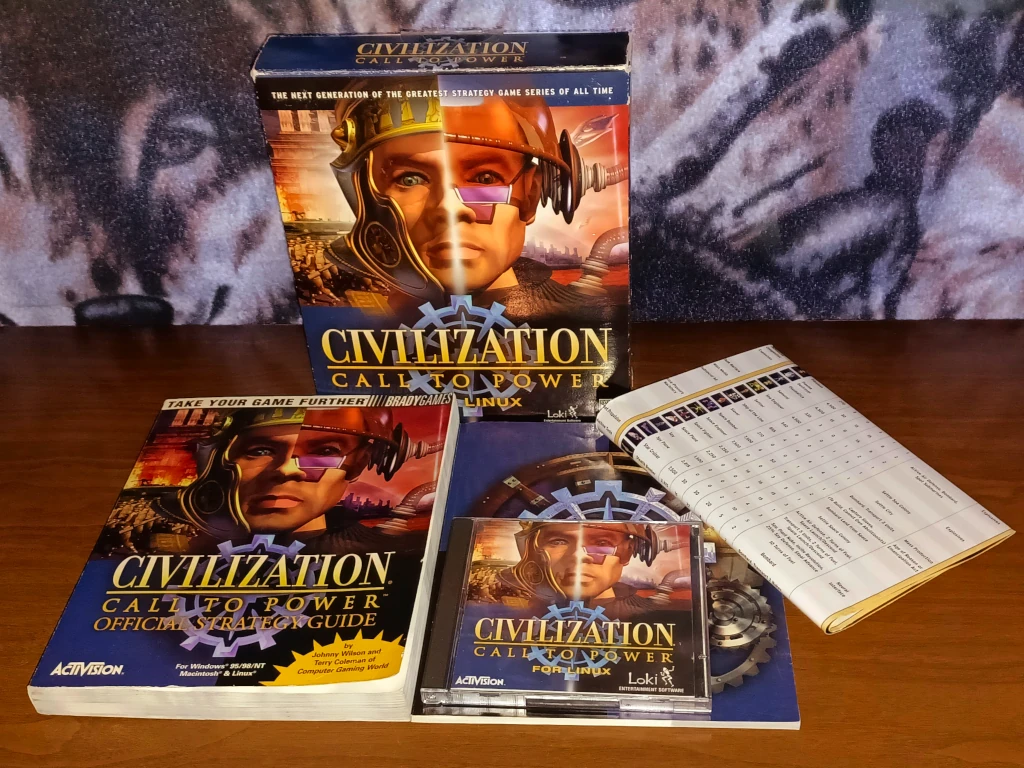
Civilization: Call to Power is a curious cultural artifact in a number of ways. Developed without accreditation from Sid Meir, the game struggled for legitimacy, taking on a hulking scope and, crucially for us, being ported to as wide a range of platforms as possible, including Linux and even later BeOS. It would be the first port released by Loki Software in May of 1999, and through that, has a claim as the first Linux game ever sold at retail. So many firsts, and yet it remains the black sheep of the family.
Even among Loki Software's other offerings Call to Power stands out, with it not using the standard Loki Setup tool, but rather one that more closely emulates the look of the installer on Windows, displaying concept art as it progresses. Freeciv was very much a thing by this point, so Call to Power did have to stand out with its presentation, showing off lavish cinematics that again required Loki Software to develop their own bespoke tools which they would continue to refine going forward.
Call to Power does struggle in other areas though, with much of the game being abstracted behind staid menus and prompts, from building up cities to talking to other nations. The result is a cumbersome user interface that buries important information, with big events such as wiping out a rival power only being heralded by unremarkable icon notifications. A tutorial is included to help wrap your head around all this, but even the game's predecessors managed to appear more engaging than this.
Starting a new game with just the defaults, I took charge as Julius Caesar of the Romans. I waged a swift campaign against the Russians, but from there my futures would begin to diverge. The Greeks were also making war on me, and being my weakest rival, I decided to march on them next. Doing this angered the Nicaraguans, with whom the Greeks had good relations, leaving me challenged from all sides. Feeling this was untenable, I loaded a prior save and opted for a more diplomatic approach.
The Nicaraguans were at war with the Portuguese, and exploiting this fact, I joined them in their crusade. This caused them to propose an alliance, which I accepted, making modest gains before the Portuguese sued for peace. I then wheeled around and curb stomped the Greeks, with their Nicaraguan protectors now sworn not to attack me. It was from here that I became stymied. I attempted to be a good ally, rejoining the fight with the Portuguese, but the Nicaraguans always left me in the dust.
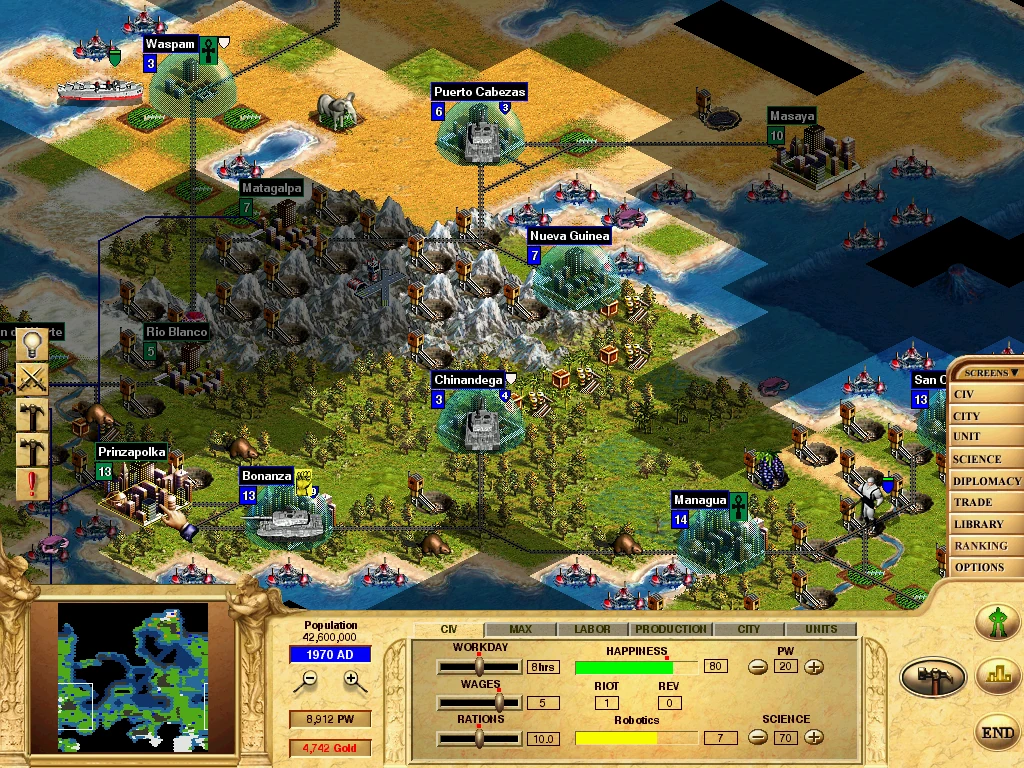
No matter what I tried, including sending spies to steal their advancements using all of the gold that they paid me, their lead in both score and overall development became unassailable. In the end I had to go back to just after I took out the Greeks again, and betray my ally early before they got too far ahead. Pitched battles followed, but I ended the war victorious and unmatched. The sequel does allow for an allied victory, but here, peace was never an option it seems.
And then the game froze after displaying the victory through conquest cinematic. Patching it from 1.1 up to the final 1.2 update resolved this, but did introduce a new issue where the game will crash if left playing the opening cinematic. I also found myself being kicked to the desktop throughout, encouraging me to save often, and perceived the CD music toggling to be inconsistent. Loki also bolted on extra multiplayer modes, as well as putting out a sprite editor and installers for switching languages.
Ultimately I did play through the game three times, including with the Loki created example scenario, and every time I was left feeling that it was uneven. Fair or not, I found myself feeling hostile to most of the more futuristic additions, especially since the past feels abridged so they could cram more of them in. Call to Power is full of gimmicks that do more to distract than enrich the Civilization experience, as fun as blasting lawyers with battle mechs can prove to be, leaving the game lopsided.
Futurology rapidly becomes dated, and the game is a bit too enamoured with too many turn of the millennium preoccupations for my taste. The biggest systemic change is the addition of sea and space colonies, causing the map to be split over two views and three zones in later ages, but I always managed to wrap things up before the game got too far into all of this. I would have preferred a custom rule to cap things at the modern day, but the developers did insist on you playing with their new toys.
Some changes I do like, such as the ability to stack up to nine units and see them engage the enemy through an accompanying battle screen, as well as the way the game deals with public works. Call to Power does have a solid core underneath all of the frippery, and did manage a follow up, titled as just Call to Power II after the Civilization rights returned to Sid Meir and company. This too would come to Linux after its source code was released in 2003, under the "Apolyton Edition" label.
Carrying on in Part 51: It’s Not Easy Being Green
Return to Part 1: Dumpster Diving





See more from me
 You can also find comments for this article on social media:
Quoting: gbudnyDid you find any commercial games for Linux published in 1997?This officially bothers me. Can't really say for commercial, but I did dig up the original 1997 incarnation of the Game Tome: https://web.archive.org/web/19970806044626/http://www.cs.washington.edu/homes/tlau/tome/byname.html
It's the only year when I didn't find any commercial games released for Linux. I hope it's not true because it would be depressing to wait for over a year for Quake 2 and Ultima Online:
1994 Doom, Doom 2
1995 Abuse, SimCity
1996 Inner Worlds, Quake
1997 Nothing?
1998 Quake 2, Ultima Online
Maybe someone remembers it.
https://www.ibiblio.org/pub/linux/docs/LSM/LSM.1999-08-30#:~:text=Last%20Defender%20demo%20Version:%201.0.5%20Entered%2Ddate:%2019NOV96%20Description
https://web.archive.org/web/19990218154129/http://www.spinne.com/x/games/ldefender/
Unfortunately ibiblio does not seem to still preserve the demo, so hopefully its on an old CD somewhere.
Last edited by Technopeasant on 15 Feb 2026 at 10:42 am UTC
https://www.mobygames.com/game/89740/terroid/
http://www.dngames.de/old/terroid.html
https://web.archive.org/web/19990219172316/http://www.spinne.com/x/games/terroid/
https://web.archive.org/web/19970805172714/http://www.informatik.uni-oldenburg.de/~miha/baller.html
https://www.youtube.com/watch?v=ksJBDfCoye0&t=12s
Last edited by Technopeasant on 15 Feb 2026 at 10:42 am UTC
Last edited by Technopeasant on 15 Feb 2026 at 4:01 pm UTC
Quoting: HamishOur federal institutions are obligated to provide services in French, and commercial packaging bears both French and English labels (what I like to call "cereal box French"), but beyond that you would be hard pressed to ever need to learn or use French in Alberta where I live.That's interesting. I always thought that people learn foreign languages because they want to read books, watch movies, or browse websites in those languages.
I have to admit that I don't know the regional language called Kashubian from Poland, but it's even smaller in population than the Francophone minority in Canada:
https://en.wikipedia.org/wiki/Kashubian_language
Quoting: HamishThe MS DOS version of Inner Worlds was made explicitly freeware, and the Linux version has been found and distributed on the Internet Archive, but I do intend to try and get in touch with Sleepless Software at some point to clarify the legal status of this before I would cover the game for an article.The DOS version is still on Steam, which is weird. I know that some parts of this game aren't freeware, like the editor, even for DOS users. It's great to hear that you plan to do it, and I hope you receive a positive response from Sleepless Software.
Quoting: HamishLoading up the binary distributed from old SunSITE archives displays the following message:We have probably lost the commercial game for Linux, and I didn't find any information about this game on his old website:
"LinCycles v2.1unreg by Oliver Richman.
(C) Copyright 1996 Five Wheel Horse Software.
This program is Shareware! The trial period is 30 days.
If you like LinCycles, then please register it. For only $5,
we will send you the registered version of LinCycles, plus our
nifty FWH software catalogue! Source code for all programs are
available. (see the read.me file for more information).
PLEASE REGISTER LINCYCLES! ALSO ASK ABOUT OUR REALLY COOL PDSOFTWARE CATALOG!"
https://web.archive.org/web/20010104235100/http://www.pathcom.com/~simex/opr/index.html
I also noticed that YiJing was a commercial application rather than a game created by Oliver Richman:
YiJing ::None of these games or applications is actively developed, which is terrible.
Thousands of years ago in Ancient China, wise men discovered the oracle
bones. These bones were used to tell the future and gain advice into
the nature of humanity itself. The wisdom and poetry of China, and more!
Featuring chinese (ZW/HZ) support, and many useful command line options.
YiJing 0.5beta binaries .............................. $29.99 CAN.
Quoting: Purple Library GuyWell, overall, it kind of is. But French speaking in Canada is really quite geographically concentrated--masses in Quebec which has a large population, a couple of other enclaves like the Acadians, pretty much none everywhere else. That said, in British Columbia where I live, school programs offering French immersion are quite popular . . . but North American language teaching just doesn't seem to be as effective as, say, European language teaching. I don't think most of those French immersion kids end up fluent in French once they've been out of school a few years.Thank you for sharing it. It's always great to learn something new about a different country. In my view, students decide what they are going to do with the basics of any language taught in schools.
Quoting: TechnopeasantPage mentions a shareware arcade game called Last Defender by Wouter Scholten, but this old LSM listing says it was first listed in November 1996 so close but no cigar.Thank you so much for finding this game.
https://www.ibiblio.org/pub/linux/docs/LSM/LSM.1999-08-30#:~:text=Last%20Defender%20demo%20Version:%201.0.5%20Entered%2Ddate:%2019NOV96%20Description
https://web.archive.org/web/19990218154129/http://www.spinne.com/x/games/ldefender/
Unfortunately ibiblio does not seem to still preserve the demo, so hopefully its on an old CD somewhere.
I found a demo version, and I have to try it:
http://ibiblio.org/pub/linux/games/arcade/ldef1210.lsm
http://ibiblio.org/pub/linux/games/arcade/ldef1210.tgz
Quoting: TechnopeasantSo according to MobyGames the game Terroid was released for DOS in 1996 but ported to Windows and Linux in 1997, if that counts (which since you counted SimCity, it should). Game was shareware.Thank you for finding it!
I know about this game because I found it two years ago, but I still haven't played it. It's so cool that someone is mentioning this game for Linux. The Linux binary dates back to 1998, and I hope the older version is still available.
I disagree about SimCity for Linux because it was a different story.
SimCity was a commercial title for Linux and many other Unix systems, including HP-UX, IRIX, and other systems. It was a commercial game for over a decade for Linux, and I couldn't run the demo version back then in 2005, when I found out about it. I have never bought it. I read it had a very restrictive copy protection, which made your keys useless on a different machine.
Quoting: TechnopeasantThe final complication is that the Linux version of Terroid appears to have been freeware ("Download the full game for Linux"), so one could argue that game was not commercial when it comes to our platform. Nevertheless, Terroid seems the best candidate for our list in 1997.It's still a Freeware game, but only for Linux, which happened a few times with other games.
1994 Doom, Doom 2
1995 Abuse, SimCity, Maelstrom (a Freeware game only for Linux)
1996 Inner Worlds, Quake, LinCycles, Last Defender
1997 Terroid (a Freeware game only for Linux)
1998 Quake 2, Ultima Online
It looks much better now.
I suspect that we have more of these games, but it would be difficult to find them. I guess 1996 was the best year for Linux users because companies released four commercial games.
Quoting: TechnopeasantSimilar to Maelstrom which started out as shareware for Mac OS in 1992 but was brought to Linux for free in 1995 by Sam Latinga when he was given the source code, and later became fully free and open source.Thank you for mentioning it
I wonder if the old website for the Linux version from 1995 still exists at archive.org
@Hamish
Do you plan to write articles about Terroid, Maelstrom, and older versions of LinCycles?
Last edited by gbudny on 17 Feb 2026 at 7:43 pm UTC
Quoting: EikeWell, Hamish answered it.Quoting: Hamish1999 (my fifth birthday)None of my business of course, but as I see this...
All those games and systems are not your own good olde times? What made you investigate them so deeply?
I started using Linux in 2004, which means more than a year after I got my first computer at home. Loki and many other games for Linux aren't part of my childhood, too. Hamish is really making something amazing by publishing these articles, and I can learn more about the history of games for Linux.
The commercial games helped many of us keep using this system, and I wish it were a much bigger community. You can see huge communities of retro users constantly talking about games for Windows, Mac, Amiga, and Atari. etc. So many incredible companies sacrifice their time and risk their money to help Linux users play commercial games.
Quoting: gbudnyThe commercial games helped many of us keep using this system, and I wish it were a much bigger community. You can see huge communities of retro users constantly talking about games for Windows, Mac, Amiga, and Atari. etc. So many incredible companies sacrifice their time and risk their money to help Linux users play commercial games.The main issue is that Linux has never really had any exclusives. For most of our history we have been a very small fish in a large pond, so the majority of our commercial titles have been ports or developed cross-platform. Meanwhile, our independent games have largely been free and open source (Tux Racer, SuperTux, Tux games in general), which is objectively great, but it does mean that most of these also saw releases on Windows, Mac OS X, BeOS, and your toaster.
The only ones that didn't were either games that were never popular enough to begin with (and so were forgotten regardless), or titles that were directly tied to Linux/Unix only libraries such as the early X11 games (which were mostly clones of arcade games anyway). Simply put, there has never been a reason by and large where you HAD to run Linux in order to experience a given game.
Meanwhile, Mac OS had a shareware scene even during the darkest of times for that platform, through the likes of Ambrosia Software and similar (most notably early Bungie), not to mention all the amateur games made in Hypercard. The Amiga meanwhile had developers that adopted it when it was genuinely a leading game platform (and had many releases where the Amiga version was considered the superior version to the DOS release), and even in its twilight its attempts to keep up with the PC were still unique, such as Doom-clones like Gloom and Alien Breed 3D.
Loki's Sam Latinga even touched upon this when he admitted that if he were to do it all over again he would have developed original Linux games instead of ports. Maybe he was right.
Last edited by Technopeasant on 17 Feb 2026 at 2:24 am UTC


Quoting: amataiIsn't GNULactic/Konquest a Linux exclusive ?Also available on Mac apparently, so technically not.
https://apps.kde.org/konquest/
This is cheating, but...
https://cygwin.com/packages/summary/konquest.html
Quoting: TechnopeasantThe main issue is that Linux has never really had any exclusives. For most of our history we have been a very small fish in a large pond, so the majority of our commercial titles have been ports or developed cross-platform.We didn’t have too many exclusive titles for Linux, but we had some commercial games developed on Linux and ported to other systems.
I switched to Linux because I noticed that I can play commercial games on this system, and I didn’t have many games from Windows that I wanted to play. I didn’t have these issues because I couldn’t be an experienced Windows gamer after more than a year of using it.
In 2004, I noticed that I could play Serious Sam, SOF, Heroes of Might and Magic III, Majesty and many companies were releasing new games for Linux every year. Many source ports for AVP, Duke Nukem 3D, Hexen, and others were available for Linux. It wasn’t a system for users playing the very specific genre of games, including World War 2 first-person shooters, because we had a few of them. I had to be less picky and choose between different genres of games if I wanted to have a better experience with Linux. Next, it wasn’t a system for users interested in playing AAA games every month. Rather, some of them + indie games.
Sadly, we didn’t have the online store with more than 40 games because everything was fragmented, and the majority of companies had their own online store with 1-3 games. Desura and USC partially fixed this problem, but they didn’t survive.
Quoting: TechnopeasantMeanwhile, our independent games have largely been free and open source (Tux Racer, SuperTux, Tux games in general), which is objectively great, but it does mean that most of these also saw releases on Windows, Mac OS X, BeOS, and your toaster.Indie games are a very interesting topic when it comes to commercial games for Linux.
Let’s focus on Linux without looking at Windows, Mac, AmigaOS, Morph OS, AIX, or even HP-UX with two commercial games (SimCity and Dominions). We had some well-known titles released for Linux between 1994 and 2000, with some rare releases of indie games. I only focus on comparing games released for Linux, including triple-A titles and indie games, released every year.
In 2001, indie games had become more noticeable on Linux with Mobility, Bunnies, Odyssey By Car, Absolute Patience, and many others. From now on, small companies have started releasing more indie games than commercial triple-A titles for Linux. Back then, every company released one or two indie games for Linux. Meanwhile, the popular games had been published mostly by LGP, Runesoft, ID, etc., and some of them were frequently ported to Linux by Ryan Gordon. They gradually became a minority among indie games.
Companies like GarageGames and Absolutist were among those with the highest number of indie games published for Linux. The general growth of commercial games continued to 2010-2011. In 2010, we didn’t have any triple-A titles for Linux, but just indie games, and we had many more of these.
For example, Kristanix Games released 11 games for Linux, which was incredible.
Many new companies joined, including Blendo Games, Kot-in-Action, Lost Luggage Studios, and Red27 Studios, among others. The success of HIB and the availability of Desura and USC probably motivated Valve to release Steam for Linux.
Quoting: TechnopeasantThe only ones that didn't were either games that were never popular enough to begin with (and so were forgotten regardless), or titles that were directly tied to Linux/Unix only libraries such as the early X11 games (which were mostly clones of arcade games anyway). Simply put, there has never been a reason by and large where you HAD to run Linux in order to experience a given game.What was more important for me was whether Linux had more or fewer commercial games released every year. For example, Voltley, which was exclusively available for Linux, was an interesting tidbit. However, we had some games developed on Linux, including Inner Worlds, Professor Fizzwizzle, and, less popular, The Last Sorcerer. Maybe, more.
Quoting: TechnopeasantMeanwhile, Mac OS had a shareware scene even during the darkest of times for that platform, through the likes of Ambrosia Software and similar (most notably early Bungie), not to mention all the amateur games made in Hypercard. The Amiga meanwhile had developers that adopted it when it was genuinely a leading game platform (and had many releases where the Amiga version was considered the superior version to the DOS release), and even in its twilight its attempts to keep up with the PC were still unique, such as Doom-clones like Gloom and Alien Breed 3D.I don't think it's necessary constantly look back at other systems. Many users are unfamiliar with commercial titles released for Linux in the past. In this discussion, you found a game, Last Defender, which I never heard of during 22 years of using Linux.
Comparisons to other systems are important and interesting, but are too well-known topics for many who read these comments. I can give you more examples. However, it's difficult for me criticize companies for just trying to port more games to Linux. Many other systems existed years before Linux.
Sam Lantinga and Loki developed libraries that became more successful for other systems. Linux has survived many difficult situations, including the disappearance of major companies like Loki or LGP, as well as the loss of interest in porting games by notable developers such as ID Software or Runesoft. There were many others, but it's not part of this discussion. I appreciate every one of them for doing what they could and helping me play many great games.
Quoting: TechnopeasantLoki's Sam Latinga even touched upon this when he admitted that if he were to do it all over again he would have developed original Linux games instead of ports. Maybe he was right.It's an interesting opinion from a person who created SDL, and we didn't have most of these games for Linux without his project. Everyone can agree or disagree.
Last edited by gbudny on 21 Feb 2026 at 10:00 am UTC
It's an interesting opinion from a person who created SDL, and we didn't have most of these games for Linux without his project. Everyone can agree or disagree.It would be an interesting opinion for him, but unfortunately I meant Scott Draeker. I got my S names mixed up.
https://web.archive.org/web/20020202221402/http://www.newsforge.com/article.pl?sid=02/01/24/2118235
Quoting: TechnopeasantThank you for your response.It's an interesting opinion from a person who created SDL, and we didn't have most of these games for Linux without his project. Everyone can agree or disagree.It would be an interesting opinion for him, but unfortunately I meant Scott Draeker. I got my S names mixed up.
https://web.archive.org/web/20020202221402/http://www.newsforge.com/article.pl?sid=02/01/24/2118235
I know that LGP also planned to publish the original game for Linux, but they have never finished it. I wish to see a screenshot of it one day.