 Support us on Patreon
 PayPal
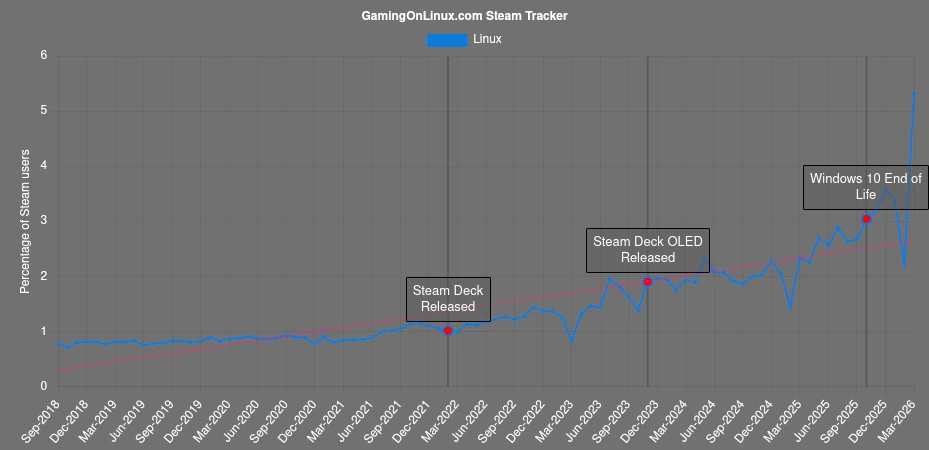
After rubbing away the sleep from my eyes in disbelief, Valve have updated the Steam Hardware & Software Survey for March 2026 showing explosive Linux growth.
For the first time, Linux has smashed through 5% hitting yet another all-time high. Showing that all of Valve's work to improve Linux gaming thanks to Proton, SteamOS and the Steam Deck have certainly turned some heads. This is after last month saw a downwards swing due to a rise in Simplified Chinese so this may be things going back to where they would be normally.
The overall numbers for March 2026:
- Windows 92.33% -4.28%
- macOS 2.35% +1.19%
- Linux 5.33% +3.10%
And the usual snapshot from our dedicated Steam Tracker trends page:
One thing that is a bit odd though, is when you filter the survey just for Linux it shows this as the top Linux distributions for March 2026:
- SteamOS Holo 64 bit 24.48% +0.65%
- 0 64 bit 17.60% +17.60%
- Arch Linux 64 bit 8.78% -0.29%
- 64 bit 8.01% +8.01%
- Linux Mint 22.3 64 bit 6.90% +0.28%
- Ubuntu Core 24 64 bit 3.58% -0.24%
- Linux Mint 22.2 64 bit 1.90% -0.69%
- Ubuntu 25.10 64 bit 1.67% +1.67%
- Manjaro Linux 64 bit 1.45% +1.45%
- Other 25.64% -5.94%
Two unnamed distributions, both with quite high percentages. So we may end up seeing some corrections this month. Hopefully just to fix the naming, but we've seen Valve correct the actual numbers before so I'll keep an eye on it.
Hopefully hardware like the upcoming Steam Machine will push Linux past 10%, then we might finally see some of those games blocked by anti-cheat start working.
Source: Valve





See more from me


 You can also find comments for this article on social media:
  Caldathras 5 hours ago
Quoting: LinuxwarperFascinating (and a highly technical read) but that's really the opposite of what I was talking about. My statement was that, these days, it seems like the Linux tools are better than the Windows tools, with features and compatibility you simply don't see in the their Windows counterparts.Quoting: CaldathrasVery much so. And it's hard to find Windows equivalents of these tools that work just as well as the Linux-based ones. I'm thinking of Mangohud in particular.There is someone developing a RadeonChill like feature called MangoChill: https://farnoy.dev/posts/mangochill. It seems promising.
 PlayingOnLinuxphone 5 hours ago

Quoting: Linuxwarper[...] and look like yet another walled garden/corporate platform like Android and Windows.That will never happen. I'm not naive enough to think "people that switch will all value free software". But Linux is already "owned" by big tech companies. Google is one of the biggest contributors to kernel, Canonical is also contributing a majority to Debian while the company has the reputation of "Microsoft of the Linux world" (at least what some people write about), but all the community projects as Debian, Arch and so on will not be destroyed, because otherwise the companies lose their own benefits in such a case.
But I am also aware that it is not a "no risk" thing. Let's face the mesa drivers for example and that they start to accept AI-written patches, which is at least an licensing issue in my opinion (if not more). AMD employees pushing AI code for example while other AMD employees assigning the change (looked into the commits myself). I see the potential issues, but I also see that it is not easy to take over a project while all other companies complaining without doing something against.
You are totally right about teaching people what free software actually is and why it matters. But I also think once they get Linux in their hand, seeing the positive differences and understand that they can communicate with developers just on forums or chats, they start to realize the benefits. Not everyone needs to know it, but as more as better. Personally I do a lot about it, even without Linux in particular, just speaking about free software or supporting it on the one way or another. Same for open hardware. My hope is a little bit: as more restrictive Big-Tech tech becomes and as more shiny free software and open hardware, as more people realize the benefits. It is much more effective than just talking to them (otherwise they understand it partly and do not care much about as long as their things keep running).
Quoting: whizseYou're a bit off, Proton was released in 2018.Indeed😂 Anyways the point I made becomes more valid with Proton not have been released. I got confused with years because Valve mentioned that development started as early as late 2015, even though it was released to public in 2018.
Quoting: CaldathrasFascinating (and a highly technical read) but that's really the opposite of what I was talking about. My statement was that, these days, it seems like the Linux tools are better than the Windows tools, with features and compatibility you simply don't see in the their Windows counterparts.It seems only logical for Linux tools to become better. If you take 1000 developers and spread them across three APIs or software projects (Metal, D3D12 and PS5 API) or unite the 1000 on a single one (e.g Vulkan) - it's obvious to me that Vulkan would likely be better if not by alot. Unless of course there is some super genius coders among the ecosystems of each of the three API projects.
Quoting: whizseThat will never happen. I'm not naive enough to think "people that switch will all value free software"They are probably less likely to if people dont enlighten them about it. As a simple example, many distros have "Welcome to X Distro" program - a part about free spirit of Linux would be nice. Whether it be effective or not is not the point, the point is that 100% users wont understand or/and realize the importance of free software if they aren't informed of it. What will happen is that they may go many years, if they are youngsters, and learn from experience that they care about free software. Where as ideally you would want users to see value in FOSS/free software from first month of using Linux.
Quoting: whizseBut Linux is already "owned" by big tech companies. Google is one of the biggest contributors to kernel, Canonical is also contributing a majority to Debian while the company has the reputation of "Microsoft of the Linux world" (at least what some people write about), but all the community projects as Debian, Arch and so on will not be destroyed, because otherwise the companies lose their own benefits in such a case.Yes. And that "ownership" can go down a worse path once user base grows. When Linux had 1% Steam market share it was insignificant and not worth paying attention to but at 10%-50% (France is adopting Linux for government), there will be more incentive to get involved and influence Linux ecosystem. Regardless of the actors being greedy and corrupt or benevolent free spirited companies. It may be difficult and take a long time but I am positive with growing popularity there will be (more) attempts at hijacking and controlling Linux projects and ecosystem. And I repeat what I said, forking a project does not bring with it the developers who revolve around the project.
Quoting: whizseBut I am also aware that it is not a "no risk" thing. Let's face the mesa drivers for example and that they start to accept AI-written patches, which is at least an licensing issue in my opinion (if not more). AMD employees pushing AI code for example while other AMD employees assigning the change (looked into the commits myself). I see the potential issues, but I also see that it is not easy to take over a project while all other companies complaining without doing something against.Yes, but these companies interests sometimes align. Take Entertainment Software Association, games, they all would LOVE TO normalize 70$ pricing. And after 70$ they would love to normalize 80$. So these companies who rely on Linux may all see benefit for them all in something bad, e.g data logging (just as a pure example). They will then be able to use their collective influence to more easily get said thing injected into Linux kernel or whatever major project it is.
Quoting: whizseYou are totally right about teaching people what free software actually is and why it matters. But I also think once they get Linux in their hand, seeing the positive differences and understand that they can communicate with developers just on forums or chats, they start to realize the benefits. Not everyone needs to know it, but as more as better. Personally I do a lot about it, even without Linux in particular, just speaking about free software or supporting it on the one way or another. Same for open hardware. My hope is a little bit: as more restrictive Big-Tech tech becomes and as more shiny free software and open hardware, as more people realize the benefits. It is much more effective than just talking to them (otherwise they understand it partly and do not care much about as long as their things keep running).I think a friendly prompt of "This is what makes Linux great! - Click here to read", or something similar, can't hurt. I dont think we should annoy anyone but enlightenment and informing others is something I believe will help in making users more resilient and aware of harmful practices and tactics and what it can lead to.
Last edited by Linuxwarper on 11 Apr 2026 at 8:43 pm UTC


Quoting: PlayingOnLinuxphoneProton released in 2018. I haven't forgotten.Quoting: CatKillerThe way I interpret the data is something like this:You forgot 2025, the year of Linux and Proton.
Nothing has fundamentally changed about Linux gaming since then - there have been incremental improvements, sure.
But the perception of Linux gaming sure has changed a ton with the coverage of Valve's high-profile Linux gaming demonstration device. So people are more willing to try it. Hence the growth.
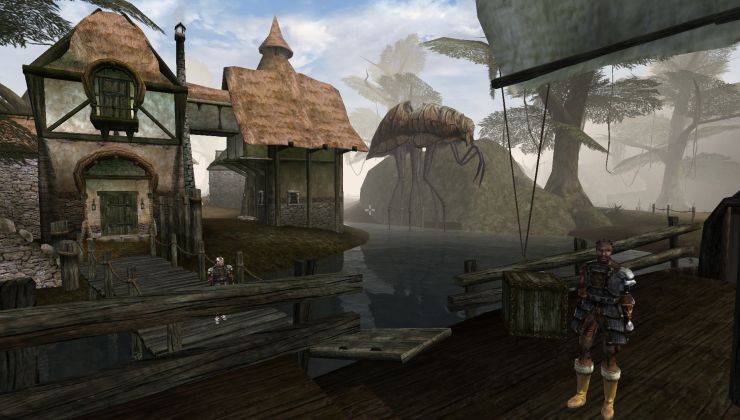 How to setup OpenMW for modern Morrowind on Linux / SteamOS and Steam Deck
 How to install Hollow Knight: Silksong mods on Linux, SteamOS and Steam Deck