Return to Part 1: Dumpster Diving
Continued from Part 51: It’s Not Easy Being Green
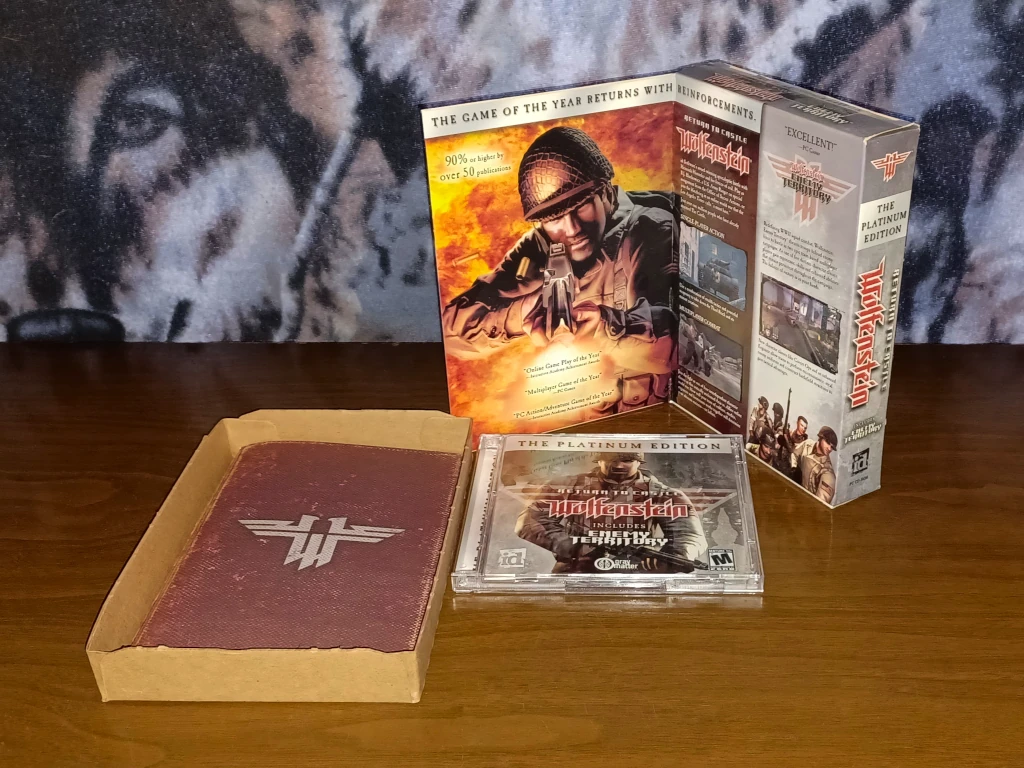
Following the demise of Loki Software the future became very uncertain for commercial gaming on Linux, but for id Software, the one developer that could boast a significant pedigree on the platform even beforehand, things would be business as usual. Timothée Besset was brought on board to continue Linux support for Quake III Arena, and he would soon pick up the mantle left by Dave Taylor and Zoid Kirsch by releasing an unofficial Linux installer for Return to Castle Wolfenstein.
In order to copy the data files from the original retail release of the game you would have to first extract them by going through the Windows installer, but this issue is sidestepped if you own either the "Game of the Year Edition" or the "Platinum Edition". With these, you can just go ahead and copy all of the PAK files with the extension ".pk3" from the "Setup/Data/Main" directory on both of the CD-ROMs to the "main" directory in the file path you generated by running the Linux installer.
By covering Return to Castle Wolfenstein I am not only in the unusual position of already being familiar with the game itself, but the last time I played through it was using this very port. It was 2011, and the source code had only just been released by id the previous August, meaning work on more modern source ports was still ongoing. As such coming back to it feels very much like sitting down to some comfort food, even if running the game proved to be quite demanding on the hardware.
I was able to get through the demo using my ATI Rage 128 Pro, but I had most of the graphical settings cranked down to low. The Nvidia GeForce 2 MX 400 does allow me to play with higher details, but I am still held back by my Pentium III 500 Katmai, which does meet the minimum system requirements listed on the box but not by much. Knowing this I scaled back most of the labelled "Performance" options, but the game would still bog down during more complex or intense scenes.
Even then it did remain playable, with it staying fluid enough for me to enter the state of low frame rate "bullet time" I remarked upon before when playing Serious Sam. For those curious how the Linux version performed when compared to Windows, using the multiplayer "Checkpoint" timedemo available online, I achieved a score of 24.6 FPS on Red Hat Linux 7.3 as opposed to a 24.7 FPS score on Windows 98 Second Edition at High settings with all the "Performance" options disabled.
I did experience a few hitches where the game would pause and the audio would skip before returning to normal, as well as a full on crash to desktop during a frantic firefight near the end of the game. The dynamic music was also mercurial, with it blaring an action sting even after I reloaded my save upon being discovered in Paderborn, destroying the otherwise subdued ambient mood of the level. The weapon animations would also glitch out on occasion, most often while reloading.
Some of this I remembered from before, although what surprised me the most was how short the campaign is. The whole thing is very tightly choreographed, and while this gives the levels a great feeling of polish with lots of attention to detail, it does mean that you can blow through the whole thing in just a couple sittings even at the highest difficulty; I even made an effort to read all of the documents and briefing materials scattered throughout the game, something I never bothered with in the past.
Return to Castle Wolfenstein proved a trendsetter in that it helped usher in the wave of World War II first person shooters that would flood the market in the years following, many of which would also be built on the id Tech 3 engine. What gives the game its own voice is how willing it is to entertain the absurdity of its premise, from the ogling of SS She Wolves sporting boot heels so loud they fail to be covert, to the random pratfalls and comedy skits played out in broad accents by the Nazi soldiers.
What Return to Castle Wolfenstein does take seriously is its gameplay fundamentals, with the arsenal being very rewarding to use; the Paratrooper rifle is perhaps the best rifle I have wielded in any game I have played period, proving the perfect counter to the waves of hitscanners you will be put up against. It is just a shame that the stealth levels are hit or miss, often breaking the flow of the campaign and feeling as if they were included only to appease the apparent zeitgeist of the time.
One thing which has always bothered me, right from the first time I played the demo as a child, is how the surviving Nazis will still target you even in preference while being massacred by the undead in the crypts under Castle Wolfenstien. I know this is war, but in a situation like that, where they had already been betrayed and abandoned by their superiors, it would have been nice to put flags and allegiances aside for once and let our common humanity prevail. Alas, we are all animals in the end.
Carrying on in Part 53: The Rabbit's Foot
Return to Part 1: Dumpster Diving





See more from me
 You can also find comments for this article on social media:

"Return to Castle Wolfenstein"
wat

Quoting: DrMcCoy"Retro"Well, 25 years old.
"Return to Castle Wolfenstein"
wat
Pretty much as old as the Atari 2600 when RTCW was released
 Liam Squires-Hand 1 hour ago

Quoting: DrMcCoy"Retro"We're all old now I'm afraid. As pointed out by Snowdrake, Return to Castle Wolfenstein was 2001!
"Return to Castle Wolfenstein"
wat

[https://icculus.org/~hamish/retro/part52.html](https://icculus.org/~hamish/retro/part52.html)

Quoting: DrMcCoy"Retro"25 years not long enough for you? 25 years is enough time for a baby to grow up, become an adult, and graduate with a bachelor's degree. It's gonna be trippy when the generation of games that still look great in 2026 start becoming retro, like Witcher 3 for example.
"Return to Castle Wolfenstein"
wat
 Patreon
 PayPal