 Support us on Patreon
 PayPal
Latest Comments by etonbears
A peek at how many of the most popular games on Steam support Linux, December 2019 edition
29 Dec 2019 at 8:46 pm UTC Likes: 3
29 Dec 2019 at 8:46 pm UTC Likes: 3
Also interesting was a comment by ( I think ) Swen Vincke of Larrian Studios when asked about making Baldur's Gate 3 available on Stadia.
He said that a major reason for him liking Stadia as a developer is that they can provide the best game experience to everyone. If you know that Stadia can provide a high end experience to everyone regardless of Client OS and regardless of Client Hardware, you can push the boundaries higher in a game by simply saying that "potato" machine gamers are only supported through Stadia.
Given how many people in the Steam survey have low-mid range hardware, this could end up with the situation where ( for some games ) the majority of "Windows" gamers are actually playing their games remotely on Linux, which rather amuses me!
He said that a major reason for him liking Stadia as a developer is that they can provide the best game experience to everyone. If you know that Stadia can provide a high end experience to everyone regardless of Client OS and regardless of Client Hardware, you can push the boundaries higher in a game by simply saying that "potato" machine gamers are only supported through Stadia.
Given how many people in the Steam survey have low-mid range hardware, this could end up with the situation where ( for some games ) the majority of "Windows" gamers are actually playing their games remotely on Linux, which rather amuses me!
Creator of WebRTC now working on Google Stadia, Darksiders Genesis out plus more Stadia news
9 Dec 2019 at 5:30 pm UTC
9 Dec 2019 at 5:30 pm UTC
Quoting: ShmerlIf it's such a standard stack, then releasing proper desktop version after all the Stadia work should be trivial.At the moment it is a fairly standard Linux stack, but the intention is to use the server side heavily and with innovation going forward. So from their perspective, Linux gaming means using Stadia.
I partially blame Google, for being "the best friend and the worst enemy" of Linux, like Aaron Seigo put it a while ago about Android [External Link]. Same applies here. Google could do a lot more to help Linux gaming through Stadia, but they don't care.
Creator of WebRTC now working on Google Stadia, Darksiders Genesis out plus more Stadia news
8 Dec 2019 at 5:25 pm UTC
If Stadia llasts long term, I'm sure their API and development model support will expand.
I don't actually expect many native Linux releases to derive from Stadia, but am hopeful for Vulkan shader support for Windows games that we can run with Wine.
8 Dec 2019 at 5:25 pm UTC
Quoting: GuestThat's also my understanding from reading the information available. Google recognise that most developers use Visual Studio on Windows, writing their shaders in HLSL, and target their tools to help those developers.Quoting: grumpytoadWe don't really know what Google are doing behind the scenes - they might have their own shader conversion technology to vulkan at the server level. I assume that at this early stage, the working relationship between a game development studio and Google's developers probably does not give much control over the codebase to the game development studio.Actually multiple game studios have talked about their Stadia development experience. The "shader conversion" is compiling HLSL to SPIR-V (Google is involved in this, and when Stadia was announced it became clear why).
I could imagine a forked codebase, or something entirely maintained by Google's developers. It makes sense because a lot of games on their catalogue are older, and are not receiving so many patches anymore. Of course, I'm only making a hypothesis and can be off the mark.
But at any rate, IMO we can't assume the game development studio even sees the linux code, or has anything to do with it.
Google do have their own interface library, but from what I hear that's very minimal code - and mostly a surface for Vulkan to render to I think. Google also have Stadia development boxes, with remote debugging access, that they lend to developers and provide support for. They mostly run GNU/Linux (a variant of Debian I'm pretty sure), but probably some tweaks to a kernel, and likely proprietary drivers from AMD (at the very least it would be amdvlk, maybe modified to the specifics rendering for streaming).
So the game developers are building a native GNU/Linux version of their games, but the target hardware platform is controlled by, and supported by, Google. Kind of like what Valve tried to do with their Steam Machines, but with less hardware variation and more direct developer support (kind of like a console in that regard).
If Stadia llasts long term, I'm sure their API and development model support will expand.
I don't actually expect many native Linux releases to derive from Stadia, but am hopeful for Vulkan shader support for Windows games that we can run with Wine.
vkBasalt, the Vulkan post-processing layer has another new release with new effects
30 Nov 2019 at 5:28 pm UTC Likes: 4
I assume the inspiration here is ENB on Windows, but it is a very early stage according to the developer.
Hooking the Vulkan presentation call is something of a blunt tool since it processes everything, including the UI, which is not necessarily a better experience. I can see that you can improve Vulkan rendering by hooking individual pipelines to avoid processing everything, but that would probably need per-application behaviour, which can be complex to administer.
It is the sort of thing that Valve might think about as part of their pipeline caching, I suppose.
It will be interesting to see where it goes.
30 Nov 2019 at 5:28 pm UTC Likes: 4
Quoting: GuestI guess he means a user configurable mechanism for adding multiple post-process shaders from arbitrary sources.Quoting: aFoxNamedMorrisReally hoping for this to eventually support arbitrary shaders.Not sure what you mean? It's open source, you can add your own shaders just fine if you want.
I assume the inspiration here is ENB on Windows, but it is a very early stage according to the developer.
Hooking the Vulkan presentation call is something of a blunt tool since it processes everything, including the UI, which is not necessarily a better experience. I can see that you can improve Vulkan rendering by hooking individual pipelines to avoid processing everything, but that would probably need per-application behaviour, which can be complex to administer.
It is the sort of thing that Valve might think about as part of their pipeline caching, I suppose.
It will be interesting to see where it goes.
Google reveal more games with the latest Stadia Connect, including Cyberpunk 2077
20 Aug 2019 at 8:27 pm UTC
20 Aug 2019 at 8:27 pm UTC
Quoting: grumpytoadI'm honestly quite surprised by all the negativity surrounding Stadia. Is it a walled-garden ? yes... but so are a lot of game systems - I don't remember any of my mates say that about their consoles, yet they've all got one. Did anyone say that about their music streaming service before they ditched their entire CD collection ?Or even just a TV with a Chromecast dongle; some people can definitely make a financial case for it. But the service quality, real cost, and service longevity remain unknown, and all may be problematic. We'll see soon enough.
As to the price, yes it's pricey - but so are video cards. You can make your own calculations, but on a personal level I've stopped buying the high-grade cards due to price, and the service allows you to switch to basically a laptop running an intel graphics chip and play the latest games out there.
I'm not going to discount it so quickly.
Google reveal more games with the latest Stadia Connect, including Cyberpunk 2077
20 Aug 2019 at 1:56 pm UTC Likes: 1
20 Aug 2019 at 1:56 pm UTC Likes: 1
Like most of you, I'm not particularly interested in streaming games. However, I CAN see why someone fortunate enough to have reliable network bandwidth and latency might be tempted. If your only use for a PC is to play games, the cost to an individual of purchasing and upgrading PC gaming hardware probably exceeds the Stadia subscription, and the player's running costs are lower. So the main target audience is probably the living-room players that Valve has also been trying to target.
The main plus that Stadia brings for Linux gaming is that it increases the importance of Vulkan as a back-end. Every new Windows game will be likely to have a D3D11/12 back-end so that it can support XBox. With Android and Stadia both using Vulkan, many Windows games will also have Vulkan back-ends, which makes them much more likely to work well under Linux/Wine, even if there is no direct port.
I am less than convinced that there will be many Stadia games extended to support generic Linux, so long as the user base remains so small. As with consoles, a Stadia game port targets a single hardware profile, and a single software stack; this makes it much easier to test and optimise at reasonable cost. That is quite different than the cost/revenue argument for a full Linux port, which would have to deal with port+support costs for many hardware combinations and inconsistent Linux graphics stacks.
It will be interesting to see if streaming is actually sustainable as a business model. I expect their hardware spend is a fraction of what you or I would have to pay, but there is still significant cost involved, particularly if they over-provision hardware to meet expected annual peaks in demand.
The main plus that Stadia brings for Linux gaming is that it increases the importance of Vulkan as a back-end. Every new Windows game will be likely to have a D3D11/12 back-end so that it can support XBox. With Android and Stadia both using Vulkan, many Windows games will also have Vulkan back-ends, which makes them much more likely to work well under Linux/Wine, even if there is no direct port.
I am less than convinced that there will be many Stadia games extended to support generic Linux, so long as the user base remains so small. As with consoles, a Stadia game port targets a single hardware profile, and a single software stack; this makes it much easier to test and optimise at reasonable cost. That is quite different than the cost/revenue argument for a full Linux port, which would have to deal with port+support costs for many hardware combinations and inconsistent Linux graphics stacks.
It will be interesting to see if streaming is actually sustainable as a business model. I expect their hardware spend is a fraction of what you or I would have to pay, but there is still significant cost involved, particularly if they over-provision hardware to meet expected annual peaks in demand.
Ubisoft and Epic Games are now supporting Blender development
23 Jul 2019 at 11:16 am UTC
The Blender games engine was useful when written, but is less important now, as well as acting as a drag on other changes. I am sure someone will find a way to make an engine integrate with Blender if it is useful to do so.
Obviously, if you used Blender to create games, you would probably disagree. ?
23 Jul 2019 at 11:16 am UTC
Quoting: WendigoI wish they'd use the money for the new game engine. (just dreaming)I think it would be better to ensure Blender is a capable and flexible asset creator that is usable as part of a variety of games, simulations and other applications: either through an extension mechanism or embedding.
The Blender games engine was useful when written, but is less important now, as well as acting as a drag on other changes. I am sure someone will find a way to make an engine integrate with Blender if it is useful to do so.
Obviously, if you used Blender to create games, you would probably disagree. ?
What a grape day, Wine 4.9 is officially out
25 May 2019 at 4:21 pm UTC Likes: 1
Most apps don't rely on this OS capability, so Wine has probably just got around to adding the facility.
It is probably of interest to gamers mainly if you like to suspend Linux with games running, which often causes problems. Some games may work better if they know the hardware has been stopped and restarted. I suspect most games will still hate suspend, regardless of any changes, and this is just the first steps, so it probably means nothing in the short term.
25 May 2019 at 4:21 pm UTC Likes: 1
Quoting: Purple Library GuyMostly this. Early PC OS iterations assumed that all hardware was present at boot time. As more technology appeared that allowed hardware to be connected at runtime, there needed to be a mechanism for the OS to recognise changes without a reboot and install/remove a driver as necessary. Plug and Play did this, checking local and remote repositories and offering the user the option to provide a driver from disk.Quoting: gradyvuckovicI'm no expert, but I'm old so I remember the term. So, back in the day, if you had peripherals for your computer you'd have to have a driver for it; peripherals often came with CDs that had a driver for you to install. The internet was barely a thing and didn't have that kind of useful stuff on it--or a little later, it did, somewhere, but actually finding it would be a massive pain. I believe plug-and-play was Windows' marketing term for their first attempt to have pre-built drivers for various stuff already in the OS so you could plug in a thing and have it supposedly Just Work. Something like that. This was back in the Windows 95/98/like that era.Quoting: iwantlinuxgamesLikewise would love to know what this implies.Initial support for installing Plug and Play drivers.anyone who can explain what this means?
Most apps don't rely on this OS capability, so Wine has probably just got around to adding the facility.
It is probably of interest to gamers mainly if you like to suspend Linux with games running, which often causes problems. Some games may work better if they know the hardware has been stopped and restarted. I suspect most games will still hate suspend, regardless of any changes, and this is just the first steps, so it probably means nothing in the short term.
It's not good to keep things all bottled up so Wine 4.8 has been opened to breathe a little
13 May 2019 at 12:03 am UTC
13 May 2019 at 12:03 am UTC
Fixes the regression in 4.5 that stopped Origin working for anyone that wants to play EA games.
( Widely vilified, I know, but I always rather liked Bioware games, even if each new title is less appealing as time goes on: they wouldn't be alone there ).
( Widely vilified, I know, but I always rather liked Bioware games, even if each new title is less appealing as time goes on: they wouldn't be alone there ).
Epic looking fantasy RPG 'Edge Of Eternity' still plans a Linux release, not soon though
29 Apr 2019 at 11:18 am UTC
29 Apr 2019 at 11:18 am UTC
Quoting: TheRiddickSo its NOT a MMO right? I don't mind multiplayer like Outward does it but I hate huge MMO RPG, ruins the atmosphere and often results in significant single player sacrifices! (and subs)I'm particular MMOs screw single player, but any multi-player that insists on 'balancing' between classes (or equivalent) tends to make for bland mechanics and less interesting play. In my opinion, that is. :)
- The "video game preservation service" Myrient is shutting down in March
- SpaghettiKart the Mario Kart 64 fan-made PC port gets a big upgrade
- California law to require operating systems to check your age
- Run your own band in the pixel art management game Legends of Rock
- The OrangePi Neo gaming handheld with Manjaro Linux is now "on ice" due to component prices
- > See more over 30 days here
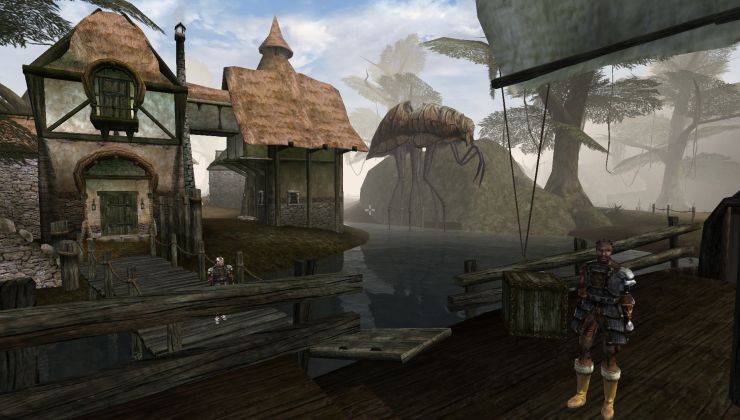 How to setup OpenMW for modern Morrowind on Linux / SteamOS and Steam Deck
 How to install Hollow Knight: Silksong mods on Linux, SteamOS and Steam Deck