 Support us on Patreon
 PayPal
Game developers should take a look at the brand new Godot Engine 4.6 release, bringing a big refresh to the popular cross-platform open source game engine.
It looks a bit different now too, thanks to the inclusion of a new more modern theme by default but the classic theme is still around for those that want it. Jolt Physics is also now included by default, even more of the UI can be moved around and docked, Screen Space Reflection (SSR) got a big overhaul and more.
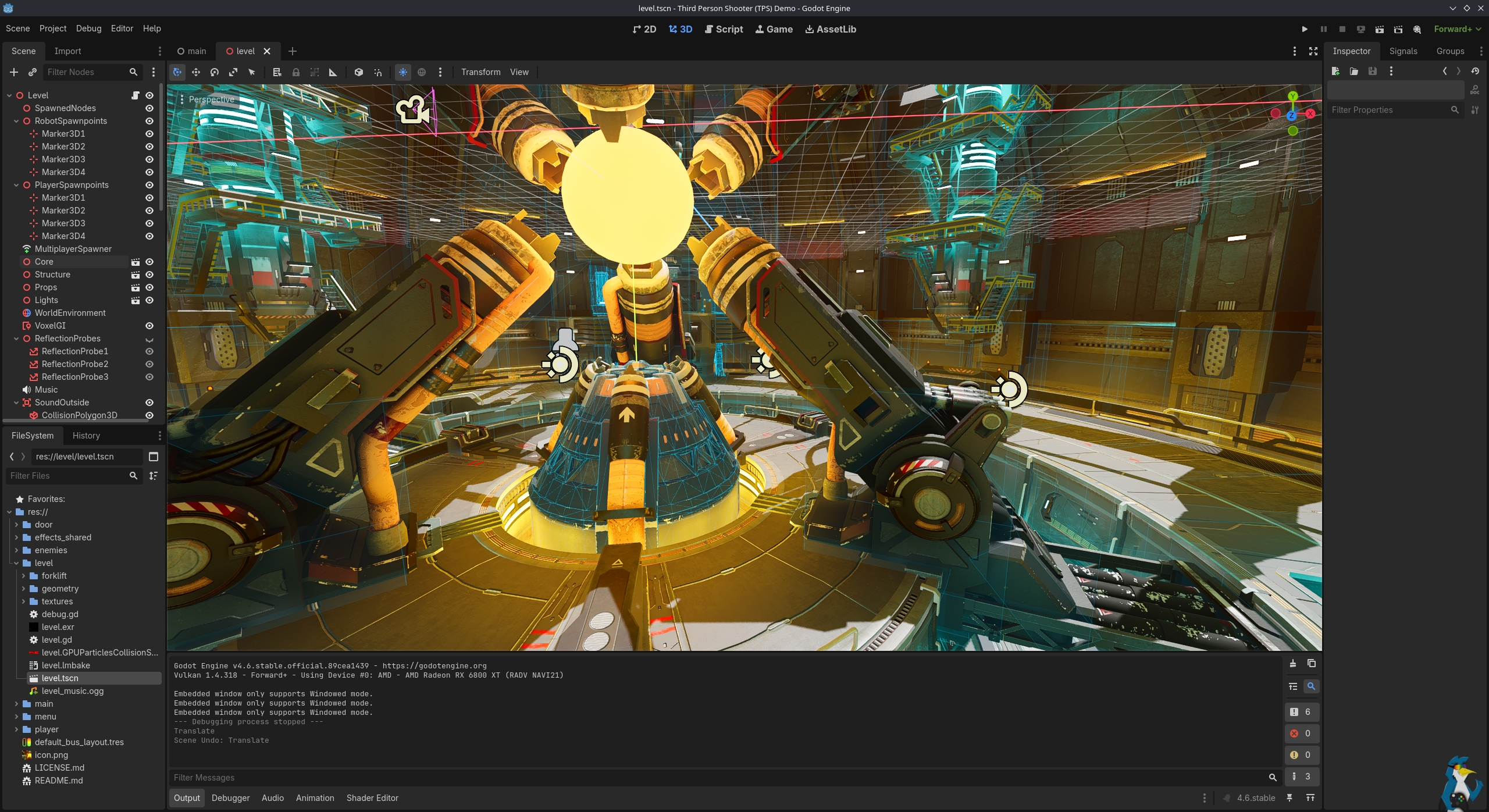
Pictured - Godot 4.6 on my Fedora KDE desktop
A truly massive addition with this release is the brand new LibGodot, a library that developers can use to embed the engine directly into their applications. Allowing full control of everything and it supports Linux, macOS and Windows.
Plenty of UI enhancements made it into this release too including the ability to switch tabs while dragging and dropping,you can add entirely new keyboard shortcuts to open up more customization for your workflow which they say also lets "plugins expose their own commands that feel like native editor actions", there's live previews in the Quick Open dialog when going through the list to pick things like textures and materials, enhancements to the animation editor to allow things like resizing animation length directly in the timeline and the list just keeps on going for a while.
A new foundation has arrived to support advanced controller features like adjusting LED light colours, and dealing with the likes of motion sensors, touchpads, haptic feedback, adaptive triggers and so on as well which sounds fun.
OpenXR support saw numerous improvements for AR / VR too including native OpenXR 1.1 support, with a compatibility layer to fall back to OpenXR 1.0. Plus the ability to use the Godot XR Editor with Android XR devices.
They also say that Direct3D 12 support should now be on-par with Vulkan, and is the new default on Windows.
There's absolutely loads more. Amazing to see such progress on free and open source software, as a great alternative to the likes of Unity and Unreal giving developers more control and no license fees.
“Almost 3 years after the 4.0 release, Godot 4 is starting to be a mature engine, including a wide array of features that enable countless developers to publish games in all genres. For example, Steam got over 1,200 new Godot games in 2025, while itch.io consistently gets around 500 new Godot games per week (game jams, prototypes, etc.).
While every Godot user still has their own favorite missing feature which they’re eagerly awaiting, for the most part the engine is fully capable. But there are still so many minor roadblocks, papercuts, workflow issues or outright bugs which can make the experience of developing and publishing games more painful than we’d like.
So for this release, there was a significant focus on polish and usability, aiming to firmly establish Godot as an engine that you can rely upon, while keeping the iteration speed, lightweightness, and flexibility which make users love it.
Close to 400 contributors were involved in this new feature release, authoring 2,001 (!) commits, and we want to thank them all for their amazing contributions, as well as all users who sponsor the Development Fund, reported bugs, opened proposals, or supported each other on our community platforms.” - Rémi Verschelde, Project Maintainer
Check out the release page for more info.





See more from me

 You can also find comments for this article on social media:

I wish they didn't make DX12 the default on Windows, that's exactly what developers are going to use and target for performance. 😫The --rendering-driver vulkan command line argument still allows you to use Vulkan, which might help with performance when running through Proton. That said, if a game does not use any modules or GDExtensions not available for Linux, you could technically perform your own unofficial native Linux port by using official export templates to replace the export template supplied with the game. It's the power of open source and game logic decoupled from the engine :)
Unfortunately, Vulkan on Windows didn't turn out as good as we initially anticipated. Many driver issues remain unsolved, especially outside of NVIDIA. (I'm fairly sure people said the same thing about OpenGL in the early 2000s...)
I see something similar happening in various emulators and recompilations, they often provide a D3D12 renderer and make it the default on Windows now. The good news is that it's much less code to target D3D12 + Vulkan than D3D11 + OpenGL, since code and shaders can be reused much more directly now (lower-level APIs make this possible). Even targeting Metal on top of that isn't much more code, and can still reuse the same shaders through translation.
Last edited by Calinou on 26 Jan 2026 at 7:42 pm UTC
They also say that Direct3D 12 support should now be on-par with Vulkan,Yay!
and is the new default on Windows.Boo!
authoring 2,001 (!) commitsGodot: A Space Odyssey
Last edited by Purple Library Guy on 26 Jan 2026 at 8:58 pm UTC
 Kimyrielle 26 Jan 2026

Quoting: GoEsrI wish they didn't make DX12 the default on Windows, that's exactly what developers are going to use and target for performance. 😫It is a funny way to promote the use of open standards, really. By all means, provide that rendering path for those who absolutely insist on it, but leave Vulkan the default.
 Arehandoro 26 Jan 2026


Quoting: GoEsrI wish they didn't make DX12 the default on Windows, that's exactly what developers are going to use and target for performance. 😫Unfortunately, NVIDIA's and AMD's Vulkan drivers on Windows is such a goddamn mess, I don't blame any developer that switches to DX12 by default. I really do hope that the drivers get better, but the Godot developers wants to make game development as seamless as possible, and that will unfortunately mean choosing a graphics API that works better, even if it's not an open standard.
Quoting: PyreticUnfortunately, NVIDIA's and AMD's Vulkan drivers on Windows is such a goddamn messThere's quite a history of poor OpenGL support from smaller GPU vendors (most of whom went out of business), and AMD has always had rather lackluster drivers (it's so much better having Red Hat, Valve, Google, and so on, doing the Linux drivers - if you've been around long enough to remember fglrx, you know how much better it is now). But as far as I know, iD did quite well making Windows games that used OpenGL and Vulkan... they were probably the largest, but certainly not the only ones?
Rather than the drivers being "a goddamn mess", I suspect a lot of it is the game engines being the problem. Godot shouldn't have that problem, but I have no idea what issues people ran into (maybe Intel and AMD Windows driver bugs?).
Quoting: Phlebiac[Here's a recent AMD Vulkan issue on Windows](https://github.com/godotengine/godot/issues/109378), that could only be fixed by switching to DX12 or waiting for a graphics driver update. Keep in mind that this was a regression, meaning that this had happened before.Quoting: PyreticUnfortunately, NVIDIA's and AMD's Vulkan drivers on Windows is such a goddamn messRather than the drivers being "a goddamn mess", I suspect a lot of it is the game engines being the problem. Godot shouldn't have that problem, but I have no idea what issues people ran into (maybe Intel and AMD Windows driver bugs?).
[Here's a recent NVIDIA Vulkan issue on Windows](https://github.com/godotengine/godot/issues/102219).
Again, no hate to either the Khronos Group or the Godot developers, but Vulkan just isn't well supported on Windows.
 How to setup OpenMW for modern Morrowind on Linux / SteamOS and Steam Deck
 How to install Hollow Knight: Silksong mods on Linux, SteamOS and Steam Deck