NVIDIA DLSS 5 arrives sometime "this fall" and brings with it many big enhancements, but it's all getting a little bit on the weird side.
I think the image they supplied with the announcement speaks for itself really:
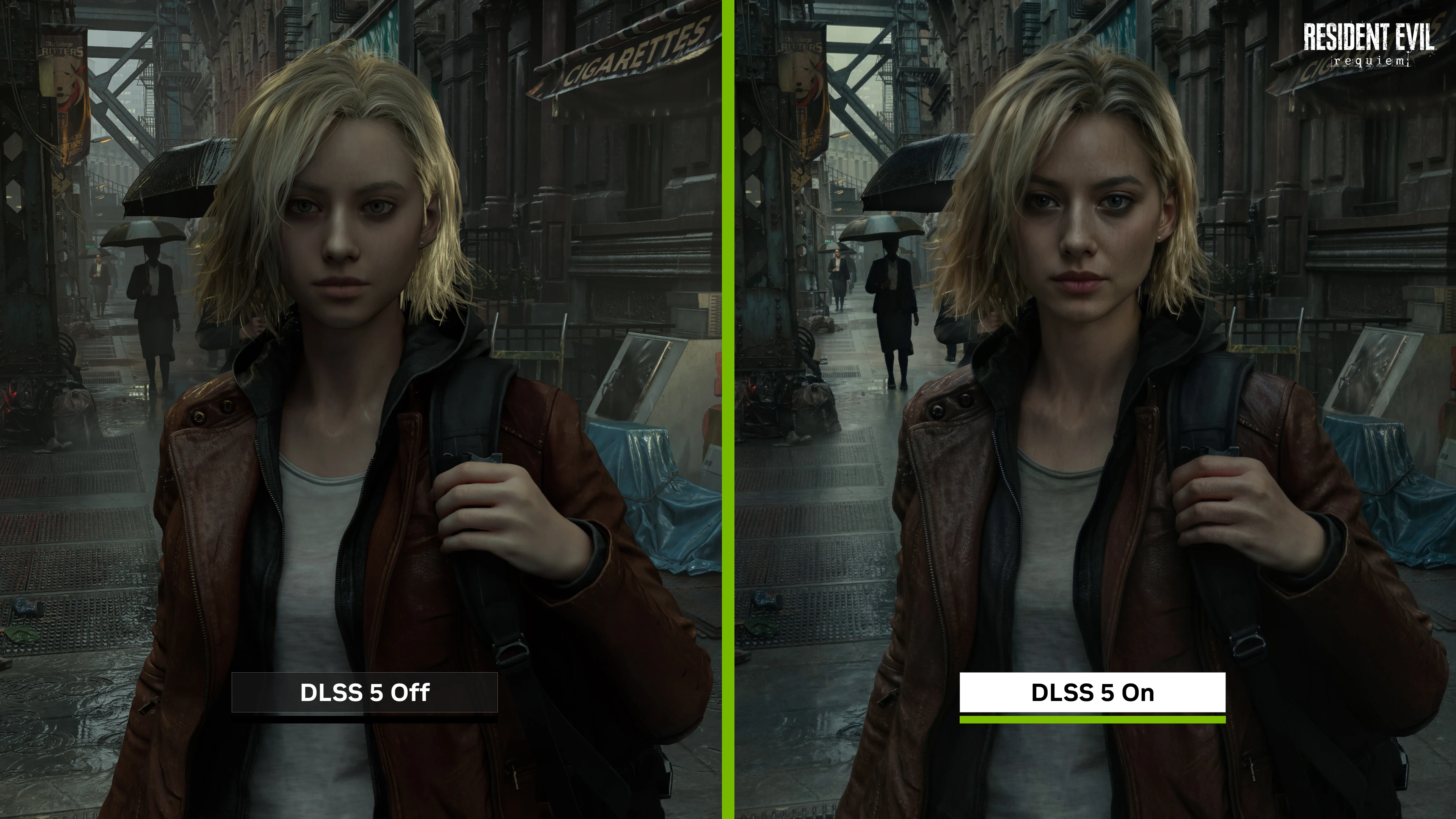
“Twenty-five years after NVIDIA invented the programmable shader, we are reinventing computer graphics once again,” said Jensen Huang, founder and CEO of NVIDIA. “DLSS 5 is the GPT moment for graphics — blending handcrafted rendering with generative AI to deliver a dramatic leap in visual realism while preserving the control artists need for creative expression.”
More from the press release:
DLSS 5 takes a game’s color and motion vectors for each frame as input, and uses an AI model to infuse the scene with photoreal lighting and materials that are anchored to source 3D content and consistent from frame to frame. DLSS 5 runs in real time at up to 4K resolution for smooth, interactive gameplay.
The AI model is trained end to end to understand complex scene semantics such as characters, hair, fabric and translucent skin, along with environmental lighting conditions like front-lit, back-lit or overcast — all by analyzing a single frame. DLSS 5 then uses its deep understanding to generate visually precise images that handle complex elements such as subsurface scattering on skin, the delicate sheen of fabric and light-material interactions on hair, all while retaining the structure and semantics of the original scene.
DLSS 5 provides game developers with detailed controls for intensity, color grading and masking, so artists can determine where and how enhancements are applied to maintain each game’s unique aesthetic. Integration is seamless, using the same NVIDIA Streamline framework used by existing DLSS and NVIDIA Reflex technologies.
NVIDIA said that DLSS 5 support will include the likes of Bethesda, CAPCOM, Hotta Studio, NetEase, NCSOFT, S-GAME, Tencent, Ubisoft and Warner Bros. Games. Some of the games already announced to have it include: AION 2, Assassin’s Creed Shadows, Black State, CINDER CITY, Delta Force, Hogwarts Legacy, Justice, NARAKA: BLADEPOINT, NTE: Neverness to Everness, Phantom Blade Zero, Resident Evil Requiem, Sea of Remnants, Starfield, The Elder Scrolls IV: Oblivion Remastered, Where Winds Meet and more.
Digital Foundry already have their own first-look with it:

Direct Link
Source: NVIDIA





See more from me


 You can also find comments for this article on social media:
  clatterfordslim 17 Mar 2026

Quoting: WanderdueneI'm not surprised to see something like this popping up in the Redering pipeline now. I'm torn about that. For games with a realistic look, this could be the final step toward achieving true photorealism. On the other hand, that could lead to more AI-generated look and make everything look increasingly generic. I really hope the developer has control over what gets used. As a developer, I'd be pissed if Nvidia's AI replaced my visual style or the appearance of characters with an AI-generated look without control over it.To me it seems fundamentally impossible that this will ever work well. DLSS only has the current frame to work with, so all of the information used to add whatever it adds to scene NVIDIA has to pull out of their ass. This is also true for upscaling which is why it will always have all the artifacts, but made up details that don't make any sense are obviously way worse.


Quoting: rustynailIt's going to be even worse. AAA studios are on-board according to nvidia. Which probably means that upper management is on-board because they see another opportunity for them to do less work and let dlss5 "pick up the slack". They did it with other forms of upscaling, they did it with raytracing and they're going to want to do it with this.Quoting: WanderdueneI'm not surprised to see something like this popping up in the Redering pipeline now. I'm torn about that. For games with a realistic look, this could be the final step toward achieving true photorealism. On the other hand, that could lead to more AI-generated look and make everything look increasingly generic. I really hope the developer has control over what gets used. As a developer, I'd be pissed if Nvidia's AI replaced my visual style or the appearance of characters with an AI-generated look without control over it.To me it seems fundamentally impossible that this will ever work well. DLSS only has the current frame to work with, so all of the information used to add whatever it adds to scene NVIDIA has to pull out of their ass. This is also true for upscaling which is why it will always have all the artifacts, but made up details that don't make any sense are obviously way worse.
I'm so sick of it that I've started refunding everything that doesn't run properly without upscaling and this only reinforces it. I don't want this crap. At least now we know that both nvidia and digital foundry are truly dead. But what will amd do? I await in fear.
Quoting: rustynailTo me it seems fundamentally impossible that this will ever work well. DLSS only has the current frame to work with, so all of the information used to add whatever it adds to scene NVIDIA has to pull out of their ass. This is also true for upscaling which is why it will always have all the artifacts, but made up details that don't make any sense are obviously way worse.To be clear, I don't know what this press release sentence means, and I'm not enthused about this whole schtick. But, this might be relevant to them claiming they can pull that off:
materials that are anchored to source 3D content and consistent from frame to frame.
Quoting: Purple Library GuyOne specific related thing I was thinking about is that because DLSS makes character faces kinda glow, it seems to sort of put fake light sources above them that don't actually exist, so I think it has no idea what is actually happening in the scene, and maybe even doesn't really have any real concept of lighting (at least in the sense in which it would be explicitly accessible to devs so they could actually tell what the model is doing rather than just spitting pixels out based on some unfathomable statistics or whatever). Tbh now that I think about it more, my argument about it only knowing about one or few frames is probably not even that important, because if something is not in the game then it's not in the game and it's going to be made up in any case, whether it's nonsensical faces or subtle random color changes all over the place.Quoting: rustynailTo me it seems fundamentally impossible that this will ever work well. DLSS only has the current frame to work with, so all of the information used to add whatever it adds to scene NVIDIA has to pull out of their ass. This is also true for upscaling which is why it will always have all the artifacts, but made up details that don't make any sense are obviously way worse.To be clear, I don't know what this press release sentence means, and I'm not enthused about this whole schtick. But, this might be relevant to them claiming they can pull that off:
materials that are anchored to source 3D content and consistent from frame to frame.

Quoting: EhvisImagine being an honest game artist and seeing your creation ruined like that. I guess there is one positive thing. You can now filter out developers that don't care about art simply by their dlss5 support!Not really, because the artists much likely won't be the ones making the decisions unless we're talking about smaller companies.
Caldathras 17 Mar 2026
 benstor214 18 Mar 2026
Quoting: ShmerlI had to look it up myself as I didn’t know, but apparently the GeForce3 was the first video card released with a programmable pixel shader. Though programmable shaders in general were already a thing for years before that.NVIDIA invented the programmable shaderThat sounds like bs. Nvidia didn't invent that.

Quoting: benstor214[apparently the GeForce3 was the first video card released with a programmable pixel shader. Though programmable shaders in general were already a thing for years before that.Yeah, they implemented such idea in the GPUs first, but they didn't invent it.
 Patreon
 PayPal
 Anticheat check - which competitive games actually work on Linux?
 How to give Valve feedback when Proton games have issues on Linux / SteamOS