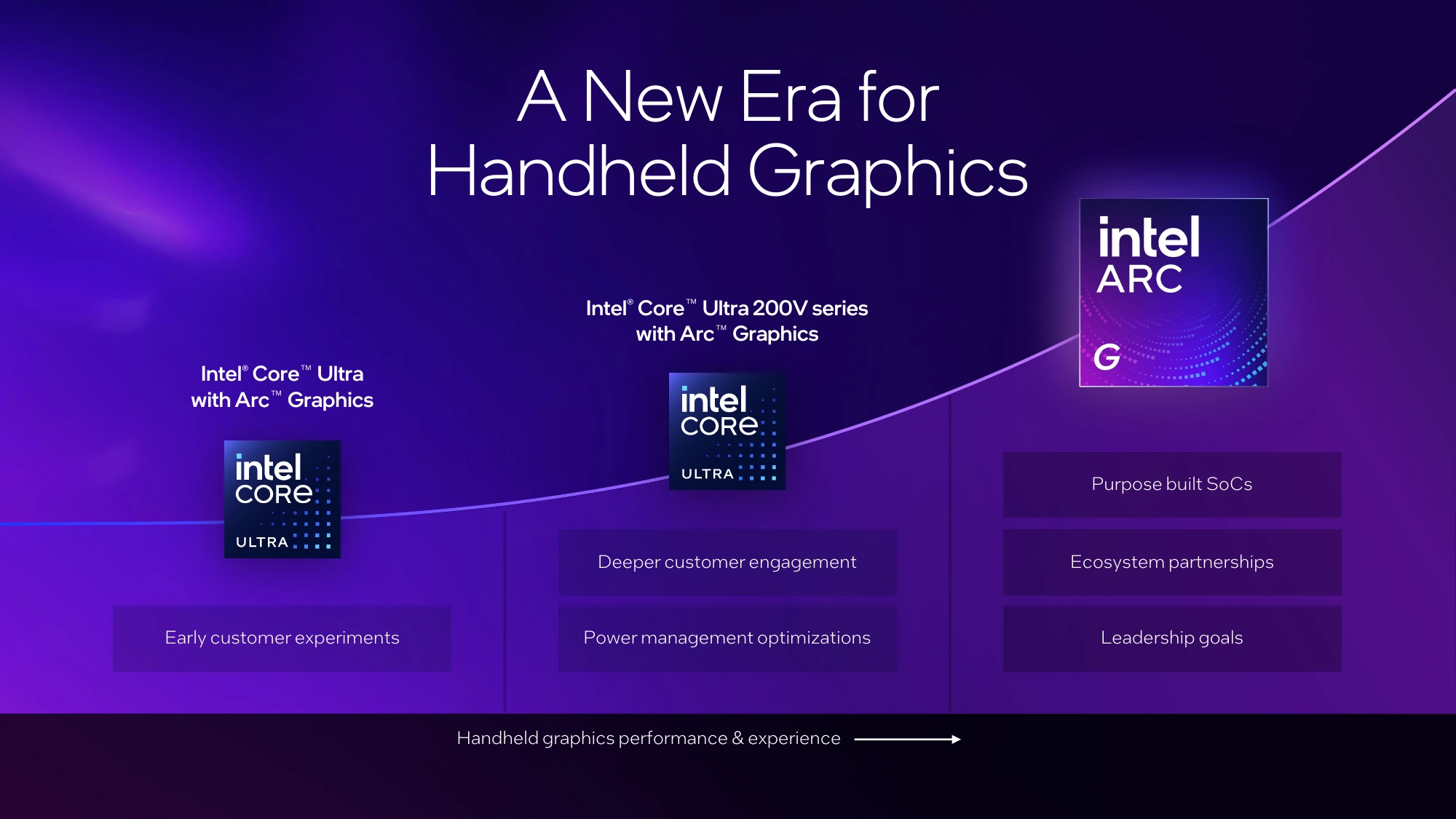
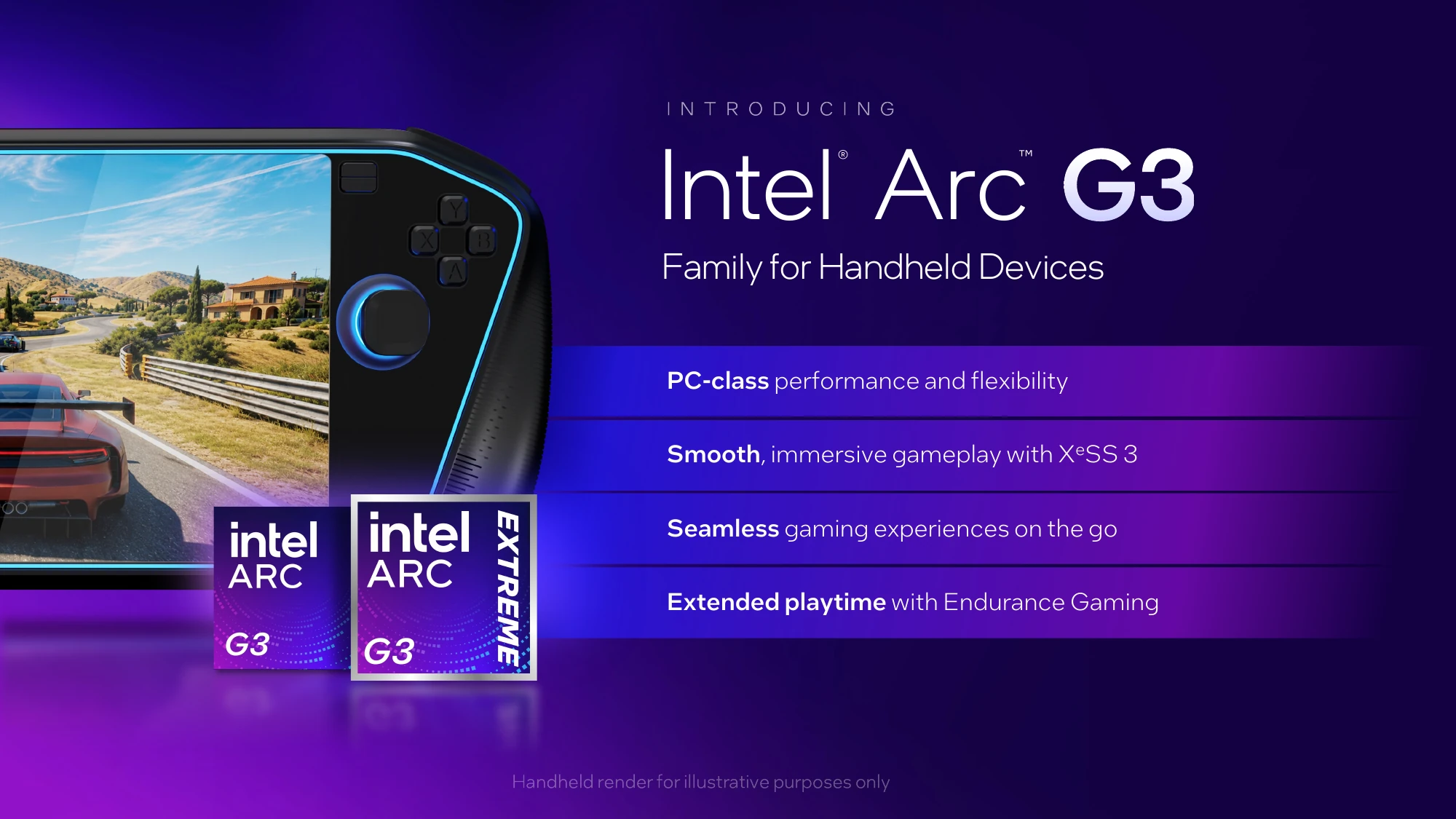
Intel are throwing their hat formally into the handheld gaming PC arena, with the official reveal of their new Intel Arc G-Series processors.
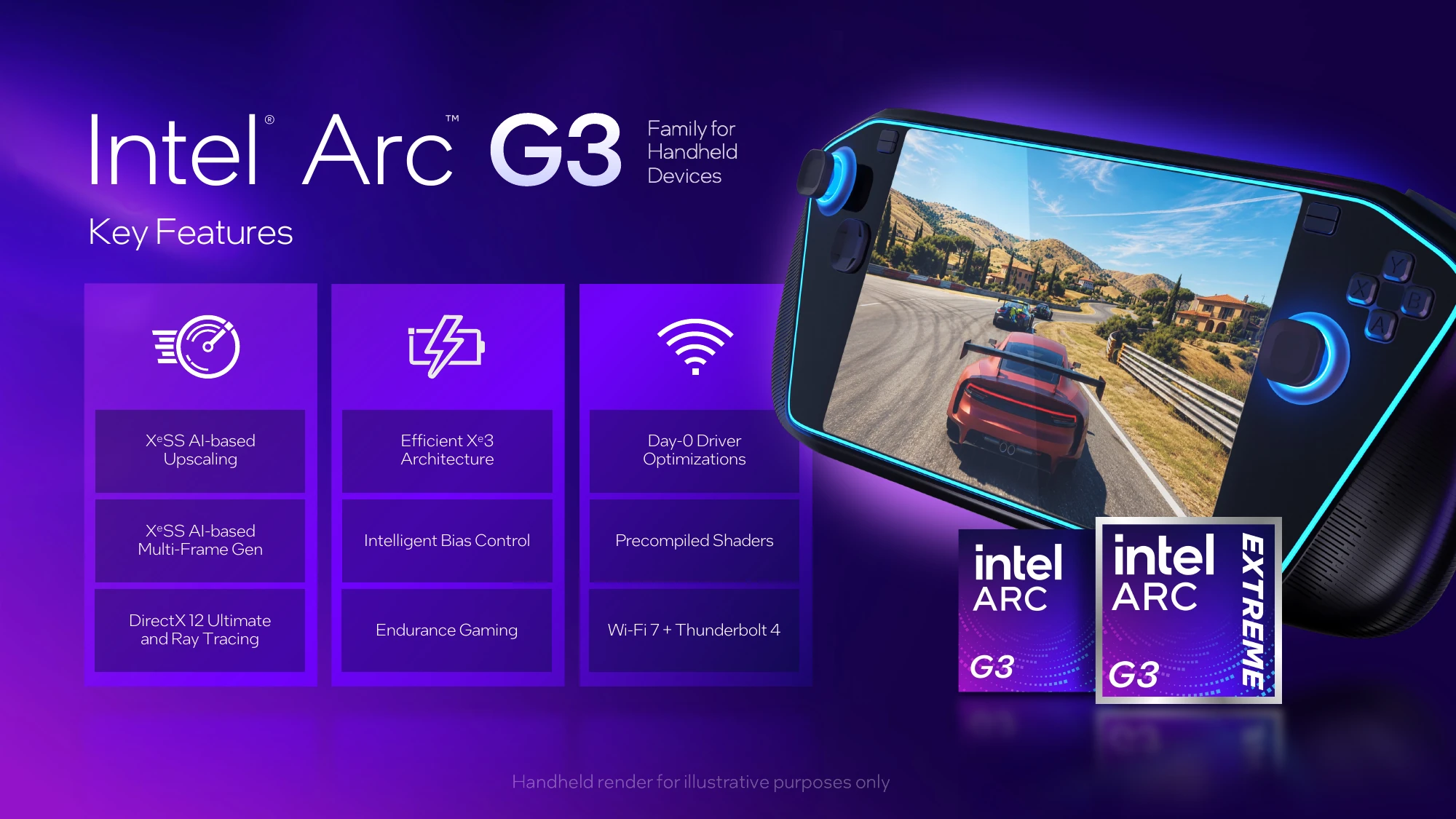
They're designed for the "next-generation" of handheld systems with the Intel Arc G3 and Intel Arc G3 Extreme that builds on the Intel Core Ultra Series 3 (code-name Panther Lake). With "up to" the Intel Arc B390 graphics built on Intel's latest Xe3 architecture. Intel said to expect hardware launches with these chips over the coming months including the Acer Predator Atlas 8, MSI Claw 8 EX AI+, and OneXPlayer. With details coming at Computex 2026 in early June.
From the press release:
"Intel Arc G-Series represents years of focused innovation and a deep commitment to gaming. It delivers uncompromising PC performance in the palm of your hand, combined with the console-like accessibility and immediacy gamers expect. With cutting-edge graphics technologies like XeSS 3 and breakthrough efficiency for longer unplugged play, Intel Arc G-Series proves that while others make tradeoffs, gamers don't have to."
Dan Rogers, Vice President and General Manager, PC Product, Client Computing Group
Intel are talking-up Windows features for it, so it will be interesting to see how the open source Mesa drivers can handle these chips on Linux systems like Bazzite, SteamOS, CachyOS and others.
More details from the press release:
Other notable specifications and features include:
- Immersive gaming with XBOX mode, a controller-optimized, console inspired, full-screen experience for Windows 11 PCs, which unifies your library of installed games.
- Faster game launches with Intel Precompiled Shaders, which downloads prebuilt shader files from the Intel cloud for select titles.
- Right-sized compute, with 2 P-Cores, 8 E-Cores, and 4 LP E-Cores manufactured on the Intel 18A process node technology, the most advanced logic node developed and manufactured in the United States.
- Advanced connectivity, including integrated Intel Wi-Fi 7 R2, dual Bluetooth 6, and Intel Thunderbolt™ 4 with support for Thunderbolt Share, giving users up to 40 Gbps bandwidth for high-speed storage, peripherals, and rapid transfer of large game libraries.
About XeSS 3: XeSS 3 enhances gaming with three key graphics technologies—XeSS Super Resolution, XeSS Multi-Frame Generation and Xe Low Latency.
- XeSS Super Resolution provides AI-based upscaling to deliver higher performance.
- XeSS Multi-Frame Generation adds multiple interpolated frames for a smoother gameplay experience.
- Xe Low Latency integrates with game engines to provide faster response to gamers' inputs, unlocking more responsive gaming.





See more from me



 You can also find comments for this article on social media:



At least more competition is still good for pricing and quality.
 Persephone the Sheep 2 days ago

Quoting: StellaThat would be cool if the Intel Mesa driver didn't suck so much. There are still so many problems in games, for example in Horizon Forbidden West you get horrible flickering whenever you look at holograms (the game has a lot of holograms)Ya the driver issues made me not buy a b580 last year. Checked for bugs before buying just to find out that games I play didn't even launch at the time or had major bugs.
 Linux_Rocks 2 days ago



Almost like the company has been steered wrong for years and years by people unfit to tie their own shoes or something. How many people did Intel axe in the last 2 years, hmm? Hint; it's over 40000 people, not AI-related reasons either... those will come later.
Clear signs of healthy business strategy if I ever saw such things.


Quoting: TightRopeI am expecting another sub par product from the Wintel duopoly.Oh, I'm sure they will fuck each other over, as per usual.
At least more competition is still good for pricing and quality.
 Caldathras a day ago
Quoting: suchOooh, portable heaters. Noice.Thanks for this. I was going to make a comment about Intel's notorious heat issues. This made me burst out laughing.
🤣
Quoting: suchOooh, portable heaters. Noice.[Intel has actually really really decreased their heat production to the point they're now competitive with the most recent ones in the M series.](https://www.tomsguide.com/computing/cpus/panther-lake-is-intels-m1-moment-but-can-it-beat-apple-silicon-we-put-these-new-chips-to-the-test)
AMD did too, but we're talking about intel here.
Turns out the issue wasn't with ARM vs X86, but 7nm vs 1.8nm, which is obvious in hindsight.
Last edited by LoudTechie on 30 May 2026 at 9:42 pm UTC
Quoting: HighballYeah calling wintel a duopoly is an insult to cartels worldwide.Quoting: TightRopeI am expecting another sub par product from the Wintel duopoly.Oh, I'm sure they will fuck each other over, as per usual.
At least more competition is still good for pricing and quality.
They're two crappy monopolies, which hate each others guts and can't do without each other, because an older monopoly made them reliant on each other.
Microsoft has tried to leave x86 [6 times.](https://en.wikipedia.org/wiki/Windows_on_ARM)(I count the copilot+ pcs as a seperate attempt, because it had extra features.).
Intel treats Linux as a first class citizen by providing open source drivers, patching the kernel and helping to develop compatible open source compilers.
They both fail hard at it, but they really try to kill each other, without committing suicide.
 Patreon
 PayPal
 Anticheat check - which competitive games actually work on Linux?
 How to give Valve feedback when Proton games have issues on Linux / SteamOS