Linux gets expanded support for Reflex and Anti-Lag tech thanks to a new open source Vulkan layer called "low_latency_layer". A first initial release is out now for anyone who wants to try it so you can fully enable the likes of AMD Anti-Lag 2 and NVIDIA Reflex 2 across many different games both Native and Windows via Proton.
From the GitHub page:
A C++23 implicit Vulkan layer that reduces click-to-photon latency by implementing both AMD and NVIDIA's latency reduction technologies.
By providing hardware-agnostic implementations of the
VK_NV_low_latency2andVK_AMD_anti_lagdevice extensions, this layer brings Reflex and Anti-Lag capabilities to AMD and Intel GPUs. When paired with dxvk-nvapi to forward the relevant calls, it bypasses the need for official driver-level support.The layer also eliminates a hardware support disparity as considerably more applications support NVIDIA's Reflex than AMD's Anti-Lag.
Going by their own benchmarks, the developer said they "suggest the layer performs as well as or better than the proprietary Windows implementations on the same hardware" which is extremely impressive - and goes to show again the power of open source:
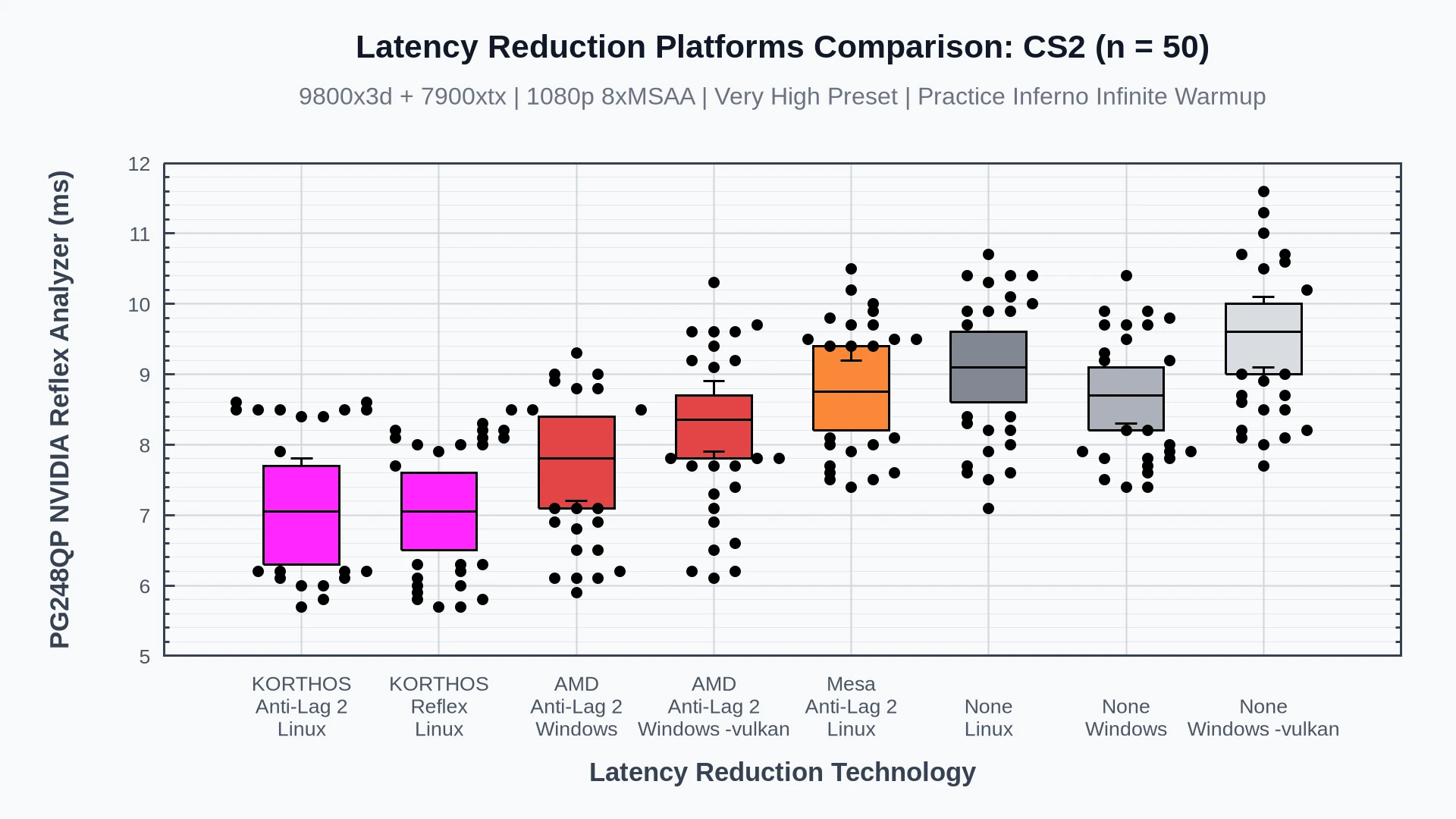
Developer comments:
- Unlike THE FINALS, where results were comparable, both technology implementations clearly beat the native Windows numbers in absolute terms.
- Reflex and Anti-Lag 2 again perform identically, consistent with our previous findings.
- CS2's
-vulkanbackend was also tested on Windows. It regresses baseline latency relative to the default backend, and AMD's Anti-Lag 2 does not recover this - it remains slower than Anti-Lag 2 on the default backend.- Mesa's Anti-Lag Vulkan layer again appears to be a no-op, matching our findings from THE FINALS.
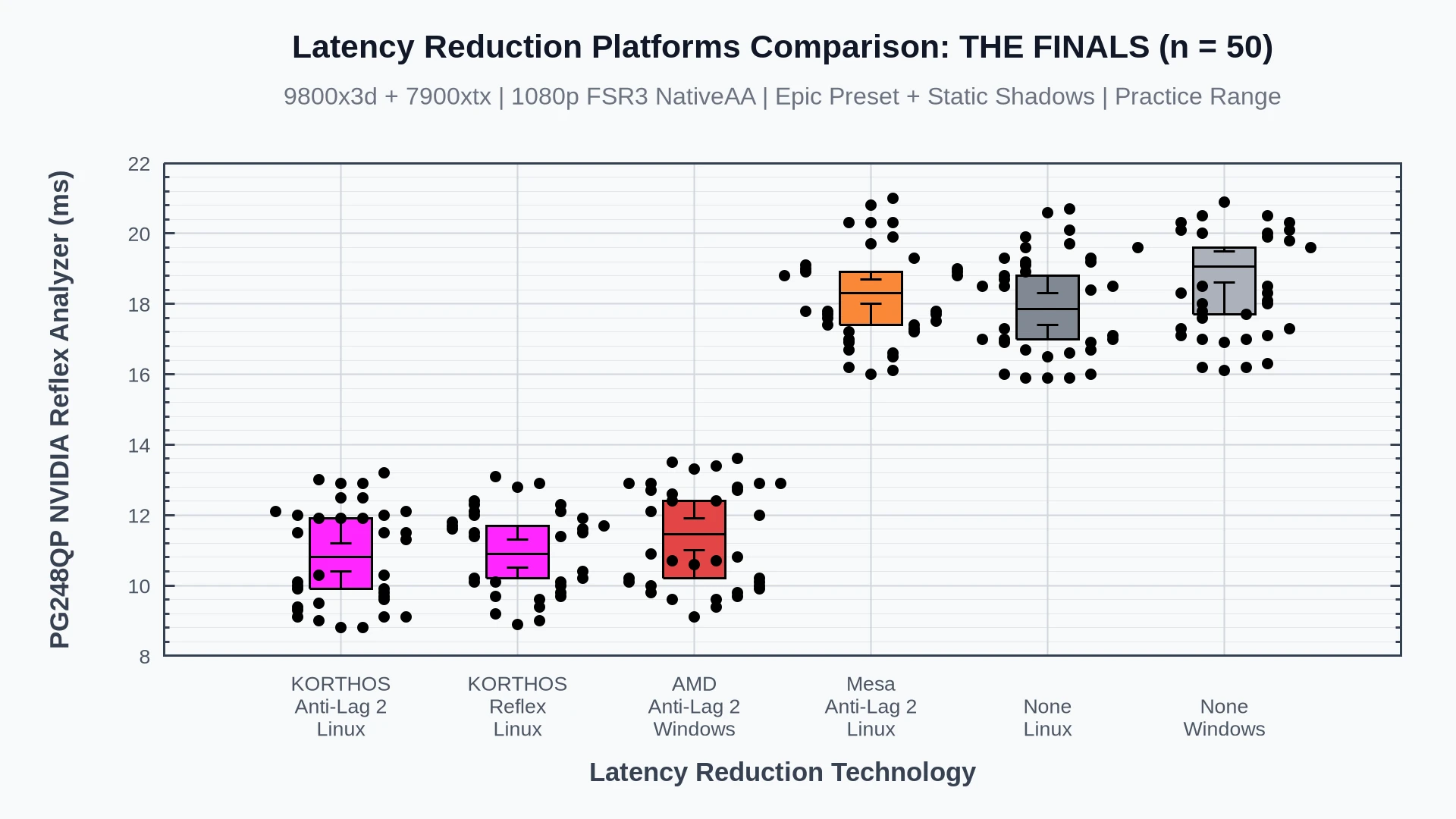
Developer comments:
- We included comparisons against AMD's proprietary DX12 implementation of Anti-Lag 2 on Windows. The results suggest latency matches or beats native Windows numbers.
- We can directly compare our implementation of Reflex and Anti-Lag technologies - they appear to perform identically as both are in line with AMD's proprietary reference implementation of Anti-Lag 2.
- Mesa's anti-lag Vulkan layer was also included in testing. It appears to be a no-op in this case as it provides no latency benefit. The data suggests it may even increase latency slightly.
More benchmarks are available on the GitHub page.
See more on the GitHub page.





See more from me


 You can also find comments for this article on social media:
 Now we need to figure out how to use it :D
I wonder if this tech is game specific or agnostic. And no, I did not use windows or gaming for more than 15 years, so no i have no idea.
Nvidia will not be happy about it and future evocations of this tech will break backward compatibility. I would bet my $ on it.
Last edited by dimko on 18 May 2026 at 9:53 am UTC
CS2 works out of the box with this thing. While installation requires console - its super easy.
Last edited by dimko on 18 May 2026 at 10:32 am UTC

By providing hardware-agnostic implementations of the VK_NV_low_latency2 and VK_AMD_anti_lag device extensions, this layer brings Reflex and Anti-Lag capabilities to AMD and Intel GPUs.From this quote I understand the new code "simply" forwards the anti-lag instructions to the current installed GPU regardless of whether the call is from nvidia or AMD libraries.
Maybe someone more expert can explain it better.

Quoting: stormtux@dimko I'm not an expert in this area but I doubt it's about reverse engineering:I didn't have a look at this implementation, but it usually is just a matter of intelligently throttling submissions to the GPU. A bit like v-sync (or at leas an FPS limiter), if you want. The only hard requirement is to have low level timing information, but that's already available as a Vulkan extension (thanks to initial work by croteam).
By providing hardware-agnostic implementations of the VK_NV_low_latency2 and VK_AMD_anti_lag device extensions, this layer brings Reflex and Anti-Lag capabilities to AMD and Intel GPUs.From this quote I understand the new code "simply" forwards the anti-lag instructions to the current installed GPU regardless of whether the call is from nvidia or AMD libraries.
Maybe someone more expert can explain it better.
Some info on a previously available vendor-agnostic open source implementation: https://blog.ishitatsuy.uk/post/latencyflex/

Quoting: stormtux@dimko I'm not an expert in this area but I doubt it's about reverse engineering:This is true, Nvidia added the VK_NV_low_latency2 Vulkan extension a while back to support Reflex2 in Vulkan and this change is about taking that and sending it to e.g VK_AMD_anti_lag if the GPU is from AMD so that Reflex2 in a game also works on AMD cards.
By providing hardware-agnostic implementations of the VK_NV_low_latency2 and VK_AMD_anti_lag device extensions, this layer brings Reflex and Anti-Lag capabilities to AMD and Intel GPUs.From this quote I understand the new code "simply" forwards the anti-lag instructions to the current installed GPU regardless of whether the call is from nvidia or AMD libraries.
Maybe someone more expert can explain it better.
AFAIK here have been no reverse engineering involved here at all.
 Patreon
 PayPal
 How to setup OpenMW for modern Morrowind on Linux / SteamOS and Steam Deck
 How to install Hollow Knight: Silksong mods on Linux, SteamOS and Steam Deck